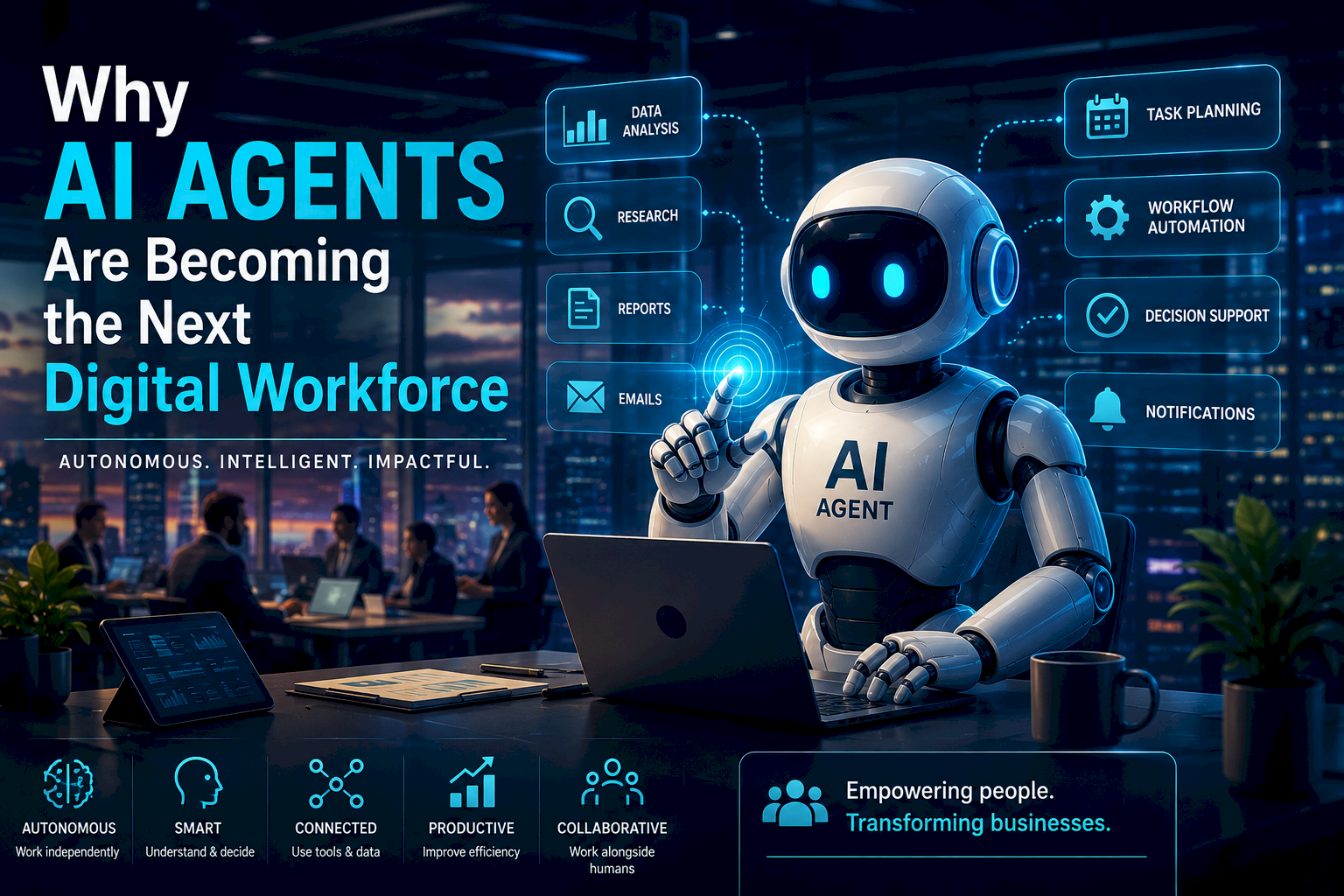
Artificial intelligence has entered a new phase. Instead of simply answering questions or generating text, modern AI systems are increasingly designed to complete tasks, make decisions within defined limits, and interact with multiple software tools. These systems, commonly known as AI agents, are rapidly becoming one of the most important technology trends for businesses around the world.
While chatbots introduced millions of people to generative AI, AI agents represent a much broader vision. They are capable of planning, executing workflows, monitoring progress, and collaborating with humans across complex business processes.
From Chatbots to AI Agents
Traditional AI assistants respond to individual prompts. Every new task usually requires another instruction from the user. AI agents work differently. They receive a goal, break it into smaller steps, use available tools, gather information, and continue working until the objective is completed or human approval is required.
For example, instead of asking an assistant to summarize sales data manually, an AI agent could collect reports, analyze trends, generate charts, prepare a presentation, and notify the responsible manager once everything is ready.
Why Businesses Are Interested
Organizations are constantly searching for ways to improve productivity without increasing operational complexity. AI agents offer a practical solution because they can automate repetitive knowledge work while allowing employees to focus on strategy, creativity, and customer relationships.
Unlike traditional automation software that follows rigid rules, AI agents can adapt to changing situations and interpret natural language instructions, making them suitable for a wider variety of business tasks.
Common Enterprise Applications
- Customer support automation
- Document analysis and summarization
- Email management and prioritization
- Software development assistance
- Financial reporting
- Market research
- Project management
- Internal knowledge search
- Data analysis and visualization
- Workflow coordination across multiple applications
The Importance of Human Supervision
Despite their growing capabilities, AI agents are not intended to replace human judgment entirely. Most organizations adopt a "human-in-the-loop" approach, where important financial, legal, medical, or strategic decisions still require human approval before execution.
This balance helps organizations gain efficiency while reducing the risks associated with autonomous decision-making.
Security and Governance
As AI agents receive access to business systems, security becomes increasingly important. Companies must carefully define permissions, monitor every action performed by an agent, maintain detailed audit logs, and limit access to sensitive information.
Effective governance ensures that AI remains a productivity tool rather than a potential operational risk.
Challenges Ahead
- Maintaining response accuracy.
- Protecting confidential business data.
- Managing operational costs.
- Building trust among employees.
- Integrating with legacy software.
- Meeting regulatory requirements.
- Monitoring autonomous decisions.
The Future of AI Agents
Industry experts increasingly believe that AI agents will become a standard layer inside enterprise software over the next few years. Instead of opening multiple applications throughout the day, employees may simply describe their objectives while AI agents coordinate the required tools behind the scenes.
This evolution could fundamentally change how organizations operate, making software less about navigating interfaces and more about achieving outcomes.
Conclusion
AI agents represent one of the most significant developments in enterprise technology since the rise of cloud computing. Their ability to coordinate tasks, access information, and collaborate with people positions them as the next generation of digital workers.
Success, however, will depend not only on increasingly powerful AI models but also on responsible governance, high-quality data, secure infrastructure, and thoughtful human oversight. Organizations that successfully combine these elements are likely to gain a significant competitive advantage in the AI-driven economy.