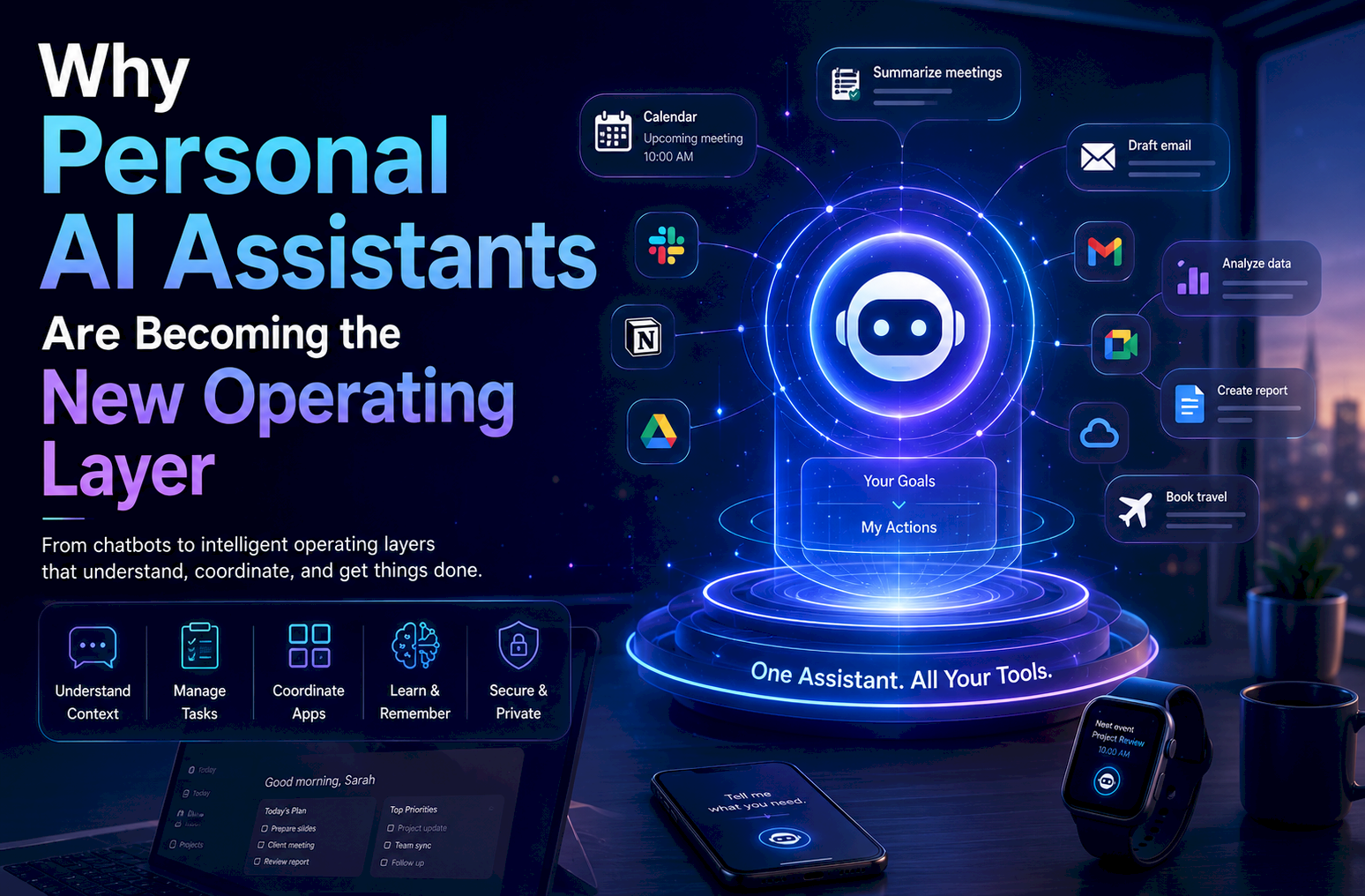
For years, digital assistants were designed around a simple interaction: users asked a question, and the software returned an answer. Artificial intelligence is now pushing that model into a much more ambitious direction. Instead of acting as another application that people open occasionally, personal AI assistants are gradually becoming a layer that sits between users and the digital services they use every day.
This shift could change the way people interact with computers, smartphones, websites, cloud services, and productivity tools. The long-term goal is no longer simply to create a chatbot that understands language. It is to build an intelligent system capable of understanding intent, remembering useful context, coordinating multiple tools, and completing increasingly complex tasks on behalf of the user.
From Answering Questions to Completing Tasks
The first generation of mainstream generative AI products was largely focused on conversation. Users could ask for summaries, generate text, brainstorm ideas, analyze information, or request explanations.
That experience was powerful, but it still required the user to manage most of the workflow. A person might ask an AI to draft an email, then manually copy the result into an email application. They could ask it to compare travel options, but still need to visit several websites and complete the booking process themselves.
The emerging generation of AI assistants aims to reduce that gap between understanding a request and carrying it out.
The Rise of Agentic AI
One of the most important developments behind this transition is agentic AI. An AI agent is designed to perform multiple steps toward a goal rather than simply produce a single response.
For example, a traditional chatbot might tell a user how to organize a business trip. A more advanced AI agent could potentially break the request into several tasks:
- Identify suitable travel dates.
- Search relevant information.
- Compare available options.
- Check the user's calendar.
- Prepare an itinerary.
- Organize related documents.
- Draft messages or reminders.
The important difference is that the AI begins to function less like a search box and more like a coordinator.
Why the Operating Layer Matters
Traditional operating systems organize applications, files, permissions, hardware, notifications, and user interactions. AI assistants are beginning to create another layer on top of these systems: one based on intent.
Instead of thinking about which application should be opened first, users may increasingly describe what they want to accomplish.
A request such as "prepare me for tomorrow's meetings" could eventually involve several services at once. An AI assistant might review the calendar, summarize relevant documents, identify important emails, organize background information, and create a list of priorities.
The individual applications would still exist, but the AI could become the interface that connects them.
Apps May Become Tools Used by AI
This transition could also change the role of applications themselves.
Today, users usually move between different apps and manually operate each interface. In an AI-centered environment, applications may increasingly expose their capabilities to intelligent assistants through APIs, tools, permissions, and structured actions.
Users might interact directly with fewer interfaces while AI systems communicate with more services behind the scenes.
That does not necessarily mean applications will disappear. Instead, many could evolve from standalone destinations into services that both humans and AI agents can use.
Context Could Become More Important Than the Prompt
Another major change involves context.
A chatbot generally becomes more useful when the user provides a detailed prompt. A personal AI assistant becomes more useful when it already understands enough relevant context to reduce the amount of information the user must repeatedly provide.
With appropriate permission and privacy controls, useful context could include:
- Calendar events.
- Frequently used applications.
- Previous conversations.
- Documents and projects.
- Communication preferences.
- Recurring tasks.
- Personalized workflows.
The more effectively an AI system can distinguish useful context from irrelevant information, the more natural the experience could become.
Memory Is Becoming a Competitive Feature
Persistent memory is closely connected to this trend.
Users generally do not want to explain the same preferences every time they start a new conversation. An assistant that remembers useful information can provide more personalized results and reduce repetitive instructions.
However, memory also introduces an important challenge: control.
Users need to understand what is being remembered, why it is being used, how long it is stored, and how it can be changed or deleted. The most successful personal AI systems will likely need to combine strong memory capabilities with clear privacy controls.
AI Could Reduce Interface Complexity
Modern software contains enormous numbers of buttons, menus, settings, filters, dashboards, and configuration screens. These interfaces exist because software traditionally requires users to understand the structure created by developers.
AI could reverse part of that relationship.
Instead of learning where a feature is located, users may simply describe the desired outcome in natural language.
Rather than navigating through several settings pages, a person might say what they want changed. Instead of learning complicated filters in a business platform, they could describe the report they need.
This could make sophisticated software more accessible to users who do not know every feature available inside an application.
The Smartphone Could Become an AI-Controlled Environment
Smartphones are particularly important in this transition because they already contain a large portion of a user's digital life.
Messages, photos, maps, calendars, payments, travel information, contacts, entertainment, health data, and work applications frequently exist within the same device ecosystem.
A deeply integrated AI assistant could potentially coordinate these services while maintaining awareness of the user's immediate context.
Instead of opening several apps to organize an evening, for example, the user might make one request and allow the assistant to coordinate maps, calendar information, messages, reservations, and reminders.
Personal AI Could Change Web Search
Search is another area likely to be affected.
Traditional search engines primarily help users locate information. AI assistants increasingly attempt to understand information, summarize it, compare multiple sources, and use the result as part of a larger task.
The distinction becomes especially important when research is only one step in a broader workflow.
A user may not actually want ten links about a product category. They may want the best option that fits specific requirements. Similarly, someone researching a destination may ultimately want a complete travel plan rather than a collection of search results.
As AI assistants improve, the value may increasingly come from transforming information into action.
Trust Will Determine How Far Automation Can Go
Greater autonomy also creates greater responsibility.
Users may be comfortable allowing an AI system to summarize documents without approval. They may be less comfortable allowing it to send messages, make purchases, modify files, or perform financial actions automatically.
This means future AI assistants will likely require different levels of authorization depending on the action.
- Low-risk actions could happen automatically.
- Important actions may require confirmation.
- Sensitive actions could require additional authentication.
- Users may need detailed activity histories for auditing AI decisions.
The quality of these controls could become as important as the intelligence of the model itself.
The Competition Will Extend Beyond AI Models
As personal assistants become more capable, technology companies may compete across an increasingly broad set of factors.
Model intelligence will remain important, but it will not be the only advantage.
Other competitive factors could include:
- Access to applications and services.
- Long-term memory.
- Device integration.
- Speed and reliability.
- Privacy protections.
- Agent capabilities.
- Multimodal understanding.
- Developer ecosystems.
- Personalization.
A slightly less powerful model connected to a highly capable ecosystem could sometimes provide a more useful experience than a stronger model with limited access to the user's tools.
The Interface Could Eventually Become Invisible
Perhaps the most interesting consequence of this transition is that the AI interface itself may become less visible.
Today, generative AI is usually associated with a chat window. In the future, intelligence could appear throughout the operating system, browser, productivity software, vehicle, wearable device, and smart home.
Users may stop thinking about "opening the AI" and instead experience AI as a capability available wherever they are working.
The technology would become less like a destination and more like infrastructure.
A New Layer of Personal Computing
The computing industry has repeatedly introduced new interaction layers. Graphical interfaces made personal computers easier to navigate. Web browsers became gateways to online services. Smartphones combined communication, computing, cameras, location, and applications into a single personal device.
AI assistants could represent another major layer.
Their defining feature would not simply be the ability to generate text or answer questions. Their real value could come from understanding goals and coordinating the digital systems required to accomplish them.
Conclusion
Personal AI assistants are evolving from conversational tools into systems capable of becoming an intelligent operating layer across a user's digital life.
The transformation will not happen simply because AI models become smarter. It will depend on reliable agents, useful memory, application integration, strong privacy controls, and the ability to safely turn user intent into action.
If these pieces come together, the most important technology interface of the next era may not be another app, website, or menu. It may simply be an AI assistant that understands what the user wants and knows how to coordinate everything required to make it happen.



.jpg)