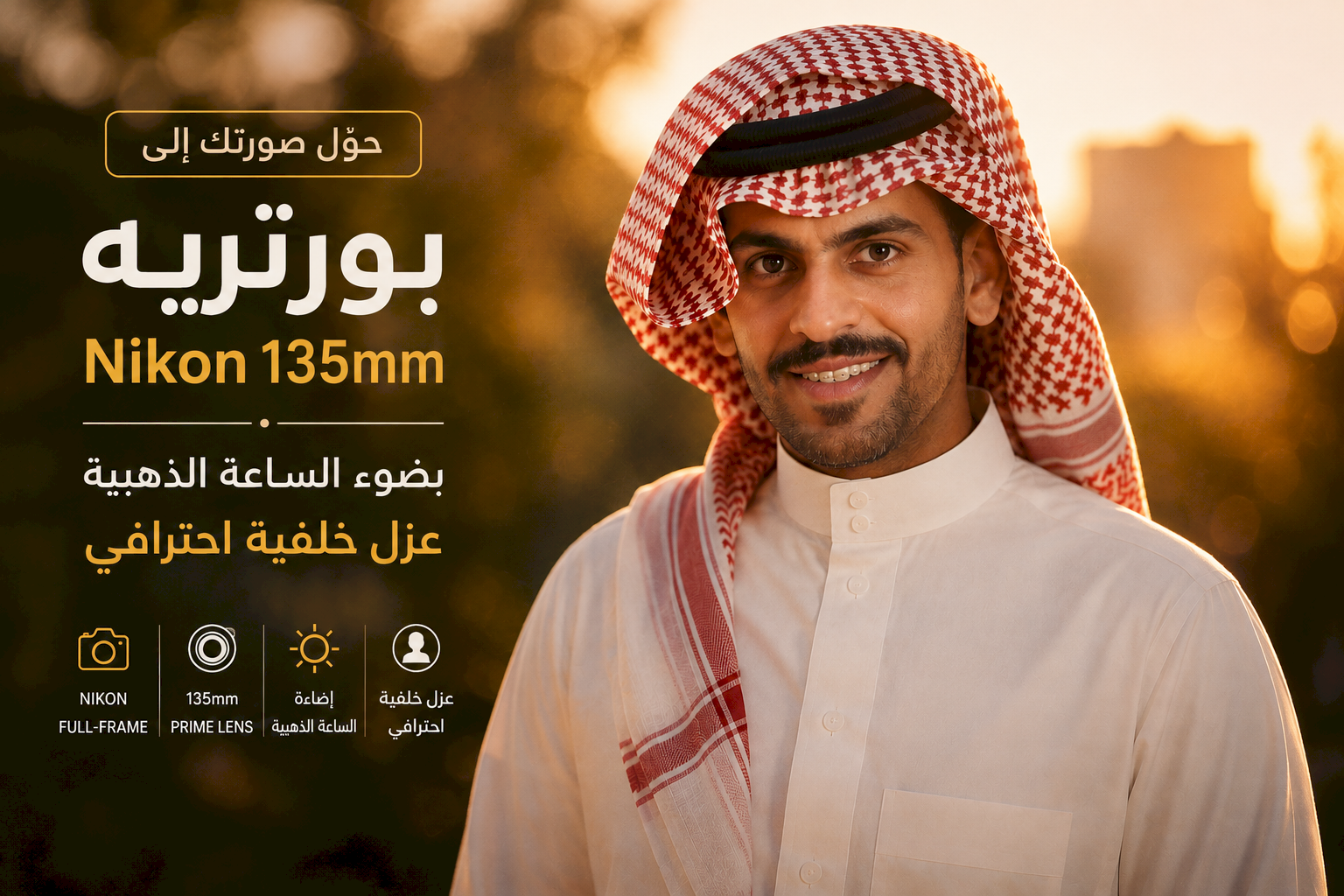
تمنح الساعة الذهبية صور البورتريه مظهرًا مميزًا يصعب الحصول عليه في أوقات النهار الأخرى، إذ تكون أشعة الشمس منخفضة وناعمة وتنتج إضاءة دافئة حول الوجه والشعر. هذا البرومبت مصمم لتحويل صورتك إلى بورتريه احترافي مستوحى من تصوير Nikon بعدسة 135mm، مع ضغط بصري جميل وعزل خلفية طبيعي وإضاءة Golden Hour واقعية، مع الحفاظ الدقيق على ملامح الشخص وهويته الأصلية.
برومبت Nikon 135mm بضوء الساعة الذهبية
Transform the uploaded photo into an exceptionally realistic professional outdoor portrait photographed during the final minutes of golden hour, inspired by the optical and tonal character of a high-end Nikon full-frame camera paired with a premium 135mm portrait prime lens.

Preserve the subject's exact identity and recognizable appearance from the uploaded photograph.

Maintain the original facial anatomy, face shape, eyes, nose, lips, jawline, eyebrows, hairstyle, hairline, facial hair, skin tone, age characteristics, expression, body proportions, clothing, accessories, headwear, and every distinctive visible feature.

The final image must unmistakably depict the exact same person.

Do not beautify, redesign, reshape, age, de-age, replace, or artificially perfect the subject.

Do not change culturally significant clothing, headwear, jewelry, accessories, or personal details visible in the source photograph.

Reconstruct the photograph as if it had genuinely been captured outdoors by an experienced professional portrait photographer using a high-resolution Nikon full-frame camera and a premium 135mm prime lens.

Simulate authentic 135mm full-frame optical perspective.

Position the virtual photographer at a realistic distance from the subject appropriate for this focal length.

Use natural telephoto compression to create flattering facial proportions and visually bring distant environmental elements closer together without distorting spatial relationships.

Photograph at approximately f/2 to f/2.8.

Keep both eyes and the essential facial plane critically focused with refined optical sharpness.

Allow focus to transition progressively through the eyelashes, ears, hair, shoulders, clothing, foreground, and background according to their actual distance from the focal plane.

Create genuine optical background separation.

Do not use artificial smartphone portrait-mode blur.

The environment behind the subject should dissolve gradually into smooth, layered, physically plausible bokeh.

Background highlights may become soft defocused discs or elliptical shapes depending on their position within the frame and the simulated lens geometry.

Keep bokeh restrained, elegant, and optically believable.

Do not fill the entire background with artificial glowing circles.

Set the scene approximately 20 to 35 minutes before sunset when the sun is low above the horizon.

Use warm directional sunlight coming from approximately 100 to 140 degrees relative to the camera, producing side-backlighting rather than flat frontal illumination.

Allow the low sun to create a delicate warm edge of light around portions of the hair, shoulders, headwear, or clothing where physically appropriate.

Do not create a complete artificial glowing outline around the person.

Illuminate the face primarily using soft open-sky illumination and natural environmental bounce.

Maintain realistic dimensional modeling across the forehead, eyes, cheekbones, nose, lips, jawline, neck, and clothing.

The face must remain correctly exposed while retaining the visual direction of the setting sun.

Use subtle warm reflected illumination on the shadow side when physically plausible.

Preserve realistic shadow depth rather than flattening the face.

Create a sophisticated golden-hour color palette.

Use warm amber and honey highlights produced by the low sun, natural skin tones, creamy neutral whites, restrained earthy browns, subtle greens, delicate blue-to-cyan separation in distant shaded areas, and softly warmed environmental colors.

Do not cover the entire image with an orange filter.

Neutral and shaded surfaces should remain visually distinct from directly sunlit areas.

Protect the subject's original skin tone above all stylistic color grading.

Skin must remain natural and individually accurate.

Preserve realistic pores, fine facial hairs, small complexion variations, subtle lines, freckles when present, eyebrow hairs, eyelashes, beard and mustache texture when present, natural lips, and authentic skin reflectivity.

Do not apply beauty filters, excessive smoothing, plastic retouching, artificial makeup, or unrealistic skin perfection.

Allow warm sunlight to interact naturally with skin.

Directly illuminated areas may become slightly warmer while open-shadow skin remains comparatively neutral.

Maintain smooth transitions between these color temperatures.

Render the eyes with exceptional realism.

Preserve the subject's original eye color, iris structure, pupil definition, scleral texture, individual eyelashes, subtle moisture, and physically accurate catchlights corresponding to the open sky and surrounding environment.

Do not artificially brighten the eyes.

Hair must contain individually resolved strands, natural density, subtle flyaway hairs, realistic highlights, authentic shadow structure, and believable interaction with low-angle sunlight.

When the sun strikes individual hair strands from behind, create subtle translucent golden separation without exaggerated glow.

Preserve the original clothing exactly whenever possible.

Render textile fibers, stitching, seams, folds, wrinkles, embroidery, buttons, patterns, and material characteristics with photographic realism.

White clothing must retain visible fabric texture and controlled highlight detail even when touched by warm sunlight.

Dark clothing must preserve material information inside the shadows.

Use the wide dynamic range of a modern professional full-frame camera.

Protect bright sunlit skin, white clothing, reflective surfaces, and the bright sky from abrupt clipping.

Maintain detailed shadows while preserving a believable black point.

Create smooth highlight roll-off around bright backlit edges.

When the sun itself or an extremely bright region appears close to the frame, allow only physically plausible optical effects.

A tiny amount of warm veiling flare, reduced local contrast, or subtle lens flare may appear when geometrically appropriate.

Do not add decorative flare when the light source could not physically produce it.

Avoid exaggerated rainbow flare, artificial light leaks, and oversized glowing haze.

Use refined Nikon-style professional color rendering with realistic skin reproduction, neutral-to-warm midtones, excellent color separation, controlled saturation, and clean tonal transitions.

Maintain extremely high perceived detail around the eyes, eyelashes, hair, and fabric while avoiding aggressive digital sharpening.

Introduce only an extremely subtle amount of natural sensor texture.

The result should remain clean and modern rather than resembling high-ISO photography or analog film.

Composition should resemble a premium outdoor editorial portrait.

Use eye-level or slightly lower-than-eye-level framing when appropriate, natural posture, authentic expression, balanced negative space, careful headroom, and elegant visual separation from the environment.

Use a believable outdoor location compatible with the original photograph.

The background may contain distant trees, understated architecture, an open landscape, a garden, a quiet urban setting, desert vegetation, or another naturally occurring environment.

Do not invent a famous landmark, culturally specific location, occupation, event, logo, vehicle, or narrative unsupported by the uploaded photograph.

Maintain complete physical consistency between the position of the setting sun, rim illumination, facial illumination, cast shadows, reflections, background brightness, bokeh, and depth of field.

All environmental lighting must feel as though it existed during one real photographic exposure.

Avoid artificial HDR, excessive orange grading, teal-and-orange blockbuster colors, plastic skin, excessive clarity, fake computational bokeh, extreme background blur, artificial glowing edges, unrealistic sun rays, oversized lens flare, fantasy lighting, distorted facial features, altered identity, malformed hands, duplicated accessories, or obvious AI-generated artifacts.

Prioritize exact identity preservation, authentic golden-hour illumination, realistic human skin, optical depth, natural telephoto compression, subtle environmental atmosphere, professional color rendering, and photographic restraint.

The finished photograph should feel like a genuine high-end outdoor portrait captured by a professional photographer at precisely the right moment before sunset.

Final result: ultra-photorealistic Nikon-inspired professional golden-hour portrait, authentic 135mm prime lens perspective at approximately f/2 to f/2.8, natural telephoto compression, precise eye focus, smooth optical bokeh, realistic sunset side-backlighting, subtle golden rim illumination, accurate natural skin tones, detailed highlight retention, dimensional open-sky facial lighting, restrained professional color grading, premium full-frame detail, elegant outdoor editorial composition, high-resolution photographic realism.
طريقة استخدام البرومبت
ارفع صورتك الأصلية إلى أداة ذكاء اصطناعي تدعم تعديل الصور، ثم انسخ البرومبت كاملًا وأرسله مع الصورة. يفضل استخدام صورة واضحة وعالية الدقة تظهر فيها ملامح الوجه والشعر والملابس بصورة جيدة، لأن البرومبت يعيد بناء الإضاءة والخلفية وخصائص العدسة مع محاولة المحافظة على هوية الشخص.
ما الذي يميز تصوير الساعة الذهبية؟
عندما تقترب الشمس من الأفق تصبح الإضاءة أقل قسوة وتميل إلى الدرجات الدافئة، ويمكن استخدامها من جانب الشخص أو خلفه لإنتاج فصل طبيعي بينه وبين الخلفية. البرومبت لا يضيف طبقة برتقالية على كامل الصورة، بل يفرق بين ضوء الشمس المباشر وضوء السماء والظلال للحصول على نتيجة أكثر واقعية.
لماذا عدسة 135mm؟
توفر عدسة 135mm ضغطًا بصريًا واضحًا يجعلها مناسبة للبورتريه الخارجي، إذ تساعد على إبراز الشخص وفصله بصريًا عن البيئة مع المحافظة على نسب الوجه الطبيعية. كما تجعل الخلفية البعيدة تبدو أقرب وأكبر نسبيًا، وهو ما يمنح الصورة مظهرًا احترافيًا مختلفًا عن عدسات الهاتف الواسعة.
عزل الخلفية والبوكيه الطبيعي
يركز البرومبت على محاكاة عمق مجال ناتج عن العدسة والمسافة الحقيقية بين الكاميرا والشخص والخلفية. ولهذا لا يتم تمويه كل ما يقع خلف الشخص بدرجة واحدة، بل تقل الحدة تدريجيًا بحسب المسافة للحصول على عزل أكثر إقناعًا.
إضاءة خلفية دون فقدان تفاصيل الوجه
تأتي الشمس في هذا الأسلوب من الجانب الخلفي لتكوين لمسات ذهبية دقيقة على الشعر أو الكتفين، بينما يحصل الوجه على إضاءته الأساسية من السماء والضوء المنعكس من البيئة. هذه الموازنة تمنع تحول الوجه إلى منطقة مظلمة عند محاكاة التصوير عكس اتجاه الشمس.
نصائح للحصول على أفضل نتيجة
- استخدم صورة أصلية عالية الدقة وبدون فلاتر مسبقة.
- اختر صورة تظهر فيها ملامح الوجه والعينان بوضوح.
- يفضل أن يكون الشخص منفصلًا نسبيًا عن الخلفية في الصورة الأصلية.
- استخدم خيار الحفاظ على الهوية إذا كانت أداة تعديل الصور توفره.
- لا تضف تمويهًا أو Lens Flare إلى الصورة قبل رفعها.
- حافظ على ألوان الصورة الأصلية حتى يستطيع النموذج تحديد لون البشرة والملابس بدقة.
النتيجة المتوقعة
ستحصل على بورتريه خارجي احترافي بإضاءة شمس ذهبية جانبية وخلفية ناعمة ذات بوكيه بصري واقعي، مع ضغط عدسة 135mm وتفاصيل دقيقة في العينين والبشرة والملابس. والهدف أن تبدو الصورة وكأن مصور بورتريه محترف التقطها بكاميرا Full-Frame في اللحظات الأخيرة قبل غروب الشمس.