Introduction
For decades, the web browser has been one of the most important gateways to the digital world. It has allowed users to visit websites, search for information, access online services, communicate, shop, work, and consume media through a single interface.
Despite its importance, the browser itself changed slowly for many years. Tabs became more flexible, security improved, extensions expanded functionality, and syncing made it easier to move between devices. Yet the basic experience remained familiar: users entered an address or search query, opened several pages, compared information, and completed tasks manually.
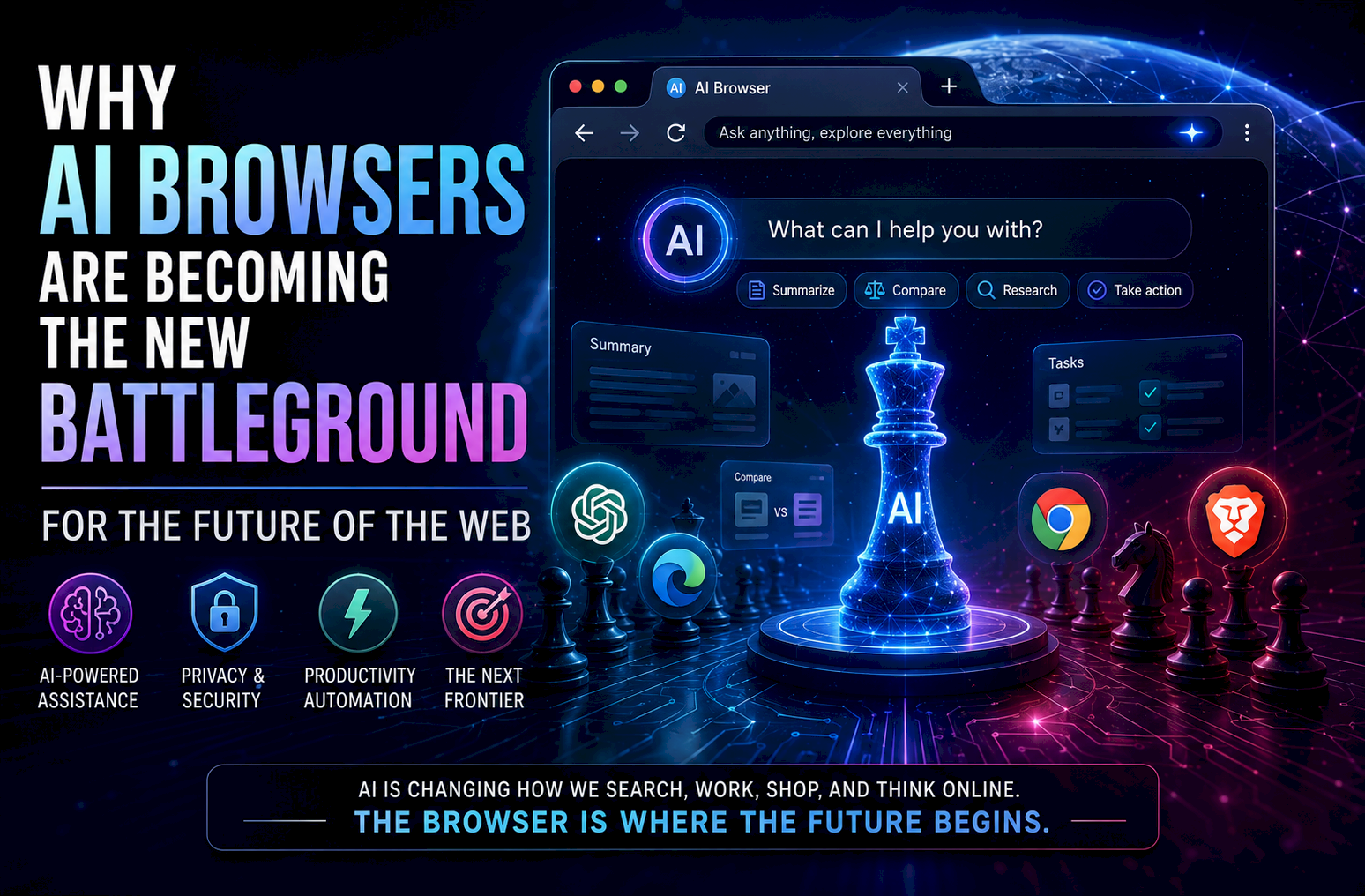
Artificial intelligence is beginning to challenge that model. A new generation of AI-powered browsers and browser assistants is attempting to transform the browser from a passive window into the web into an active digital agent that can read, summarize, compare, organize, and even perform tasks on behalf of the user.
From Navigation Tool to Intelligent Assistant
Traditional browsers are designed primarily for navigation. They display webpages and give users tools to move between them. AI browsers aim to understand the content of those pages and help users decide what to do next.
Instead of opening ten product pages and comparing prices manually, a user may ask the browser to identify the best option according to specific criteria. Instead of reading a long report, the browser may extract the key findings, explain unfamiliar terms, and generate a concise summary.
The long-term vision goes further. AI browsers may be able to complete forms, organize research, create travel plans, schedule appointments, prepare reports, manage online accounts, and move information between websites with limited human input.
Why the Browser Is Strategically Important
The browser occupies a unique position between users and the internet. It can see which websites people visit, how they search, what services they use, and how they interact with online content.
This makes the browser an ideal platform for artificial intelligence. An AI assistant built directly into the browser can work across many websites instead of being limited to a single application.
The company that controls the browser may also influence where users search, which services they discover, how information is presented, and which commercial platforms receive traffic. This is why the competition over AI browsers is not simply a race to build a better product. It is a struggle for control over the user’s digital starting point.
Search Could Become Invisible
Search engines have traditionally depended on users entering a query and selecting from a list of links. AI interfaces are changing that pattern by producing direct answers, summaries, comparisons, and recommendations.
In an AI browser, search may no longer feel like a separate activity. The user could highlight a paragraph, ask a question about the current page, request a comparison with other sources, and receive an answer without opening a traditional search results page.
This shift could reduce the importance of the search box and replace it with a continuous conversation between the user and the browser.
A Change in User Behavior
If users receive complete answers inside the browser interface, they may visit fewer websites. This could make research faster, but it may also reduce exposure to diverse sources and limit the number of pages people read directly.
The browser would no longer simply direct traffic. It would increasingly interpret the web before presenting it to the user.
The Rise of Browser-Based AI Agents
One of the most important developments is the emergence of browser agents. These systems are designed not only to answer questions but also to take actions.
A browser agent could potentially:
- Compare products across multiple online stores.
- Fill in repetitive forms.
- Collect information from several webpages.
- Book travel or make reservations.
- Prepare a spreadsheet from web data.
- Track prices or availability.
- Organize research into categories.
- Summarize email, documents, and web content in one workflow.
This changes the browser from a tool used by people into a platform where software can operate on their behalf.
Convenience Comes With New Risks
The more tasks an AI browser can perform, the more permissions it may require. It may need access to browsing history, saved passwords, online accounts, documents, payment details, calendars, and personal preferences.
This creates a difficult balance. The assistant becomes more useful when it understands the user’s context, but that same context may contain highly sensitive information.
An AI browser that can act across websites must be carefully designed to prevent unauthorized actions, accidental purchases, harmful instructions, and manipulation by malicious webpages.
Prompt Injection on the Open Web
One major security concern is prompt injection. A webpage may contain hidden or misleading instructions intended to influence the AI agent.
For example, a malicious page could attempt to convince the browser assistant to reveal private information, ignore previous instructions, or perform an unsafe action.
Traditional browsers mainly display content. AI browsers interpret and act on it, which means every webpage may become a potential source of instructions that must be evaluated carefully.
Privacy Will Become a Major Competitive Feature
Browser companies have long competed on speed, compatibility, extensions, and security. AI introduces privacy as an even more important point of differentiation.
Users will want to know:
- Which browsing data is sent to cloud servers?
- Which tasks are processed locally on the device?
- How long is browser activity stored?
- Whether conversations are used to train models?
- Which third parties receive personal data?
- How easily AI features can be disabled?
Companies that provide clear controls and transparent data policies may gain an advantage, especially among professional and enterprise users.
The Impact on Publishers and Websites
Websites depend on visitors for advertising revenue, subscriptions, product sales, and brand recognition. AI browsers could weaken that model if they extract information without sending users to the original source.
A user may receive a summary of an article, comparison, review, or tutorial without opening the page that produced the information. This can save time, but it also reduces traffic and may limit the publisher’s ability to earn revenue.
The conflict is likely to become more serious as AI browsers grow more capable. Publishers may demand clearer attribution, licensing agreements, payment systems, or technical controls that limit how their content is used.
A New Definition of Website Value
Websites may need to provide more than information that can be summarized easily. Unique tools, original reporting, expert analysis, communities, databases, interactive features, and trusted brands may become more valuable.
Content designed only to attract search traffic may become less effective if AI interfaces answer common questions directly.
Digital Advertising Faces Another Disruption
The advertising industry depends heavily on search results, website traffic, user targeting, and measurable clicks. AI browsers could disrupt all four.
If the browser summarizes several commercial pages and recommends one option, traditional display ads may receive less attention. At the same time, companies may seek to place sponsored recommendations directly inside AI-generated answers.
This raises questions about transparency. Users will need to know whether an AI recommendation is based on quality, personal relevance, commercial payment, or a partnership between the browser provider and the seller.
The distinction between helpful assistance and advertising could become increasingly difficult to see.
AI Browsers Could Reshape E-Commerce
Online shopping is one of the areas most likely to be transformed. Product search currently requires users to compare specifications, prices, reviews, delivery options, warranties, and seller reliability.
An AI browser could combine these steps into a single request. The user might specify a budget, desired features, preferred brands, and delivery deadline, then ask the browser to identify the best purchase.
This could reduce the influence of traditional search rankings and marketplace placement. Sellers may increasingly compete to be selected by automated agents rather than noticed by human shoppers.
The Problem of Biased Recommendations
If an AI browser becomes a purchasing agent, its recommendation logic will have enormous commercial value. Retailers and brands may try to influence which products the system selects.
Users may need independent tools that explain why a product was recommended and whether sponsored relationships affected the result.
Workplace Productivity May Be the First Major Success
AI browsers may achieve their fastest adoption in professional environments. Many office tasks already take place across web applications, dashboards, email systems, documents, and cloud platforms.
A browser assistant that can understand multiple tabs and move information between services could save significant time.
Potential workplace uses include:
- Summarizing market research.
- Comparing competitor websites.
- Preparing meeting notes.
- Extracting information from reports.
- Monitoring business dashboards.
- Drafting responses based on web data.
- Automating repetitive online workflows.
The value is not limited to generating text. The greater opportunity lies in connecting information across many browser-based tools.
The Browser May Become the New Operating System
Modern users already spend much of their time inside web applications. Email, documents, project management, banking, communication, entertainment, and business software often run in the browser.
If AI is added as a control layer across these services, the browser begins to resemble an operating system. It manages applications, understands user intent, connects data, and coordinates actions.
This could weaken the importance of individual websites and strengthen the company that controls the browser interface.
Traditional Browsers Still Have Major Advantages
New AI browsers may attract attention, but established browsers benefit from large user bases, mature security systems, extensive extension ecosystems, and strong compatibility with the web.
Changing browsers is not always easy. Users may depend on saved passwords, bookmarks, enterprise policies, extensions, and synchronization across devices.
For this reason, traditional browser companies may not need to rebuild the browser completely. They can add AI capabilities gradually while preserving familiar workflows.
Independent AI Browsers Face Difficult Challenges
Smaller companies can move quickly and experiment with new interfaces, but they face several obstacles.
- High costs for AI inference and cloud infrastructure.
- The need to maintain browser security.
- Limited distribution compared with major technology companies.
- Dependence on existing browser engines.
- Difficulty earning revenue without compromising user trust.
- Competition from AI features built into dominant browsers.
Their success may depend on serving specific groups such as researchers, developers, students, business teams, or privacy-focused users.
The Question of Open Standards
As browser agents begin performing actions across websites, the web may require new standards that help automated systems interact safely with online services.
Websites may need structured ways to describe available actions, permissions, pricing, identity requirements, and security conditions.
Without common standards, each browser provider may create its own system, leading to fragmentation and giving large platforms greater control over how automated agents access the web.
How AI Browsers Could Change Web Design
Websites today are designed mainly for human visitors and search engines. In the future, they may also be designed for AI agents.
Businesses may need to make product information, prices, policies, contact details, and actions easier for automated systems to understand.
This could lead to cleaner data structures and more consistent interfaces. It could also encourage companies to optimize their websites for machine selection in the same way they currently optimize for search rankings.
Will Users Trust Browsers to Act for Them?
The success of AI browsers depends on trust. Users may accept summaries and recommendations quickly, but they may be more cautious about allowing a browser to send messages, make purchases, book travel, or modify accounts.
Trust will depend on several factors:
- Clear confirmation before important actions.
- Detailed records of what the agent did.
- Easy cancellation and recovery.
- Strong protection against malicious webpages.
- Transparent handling of personal data.
- Reliable results with minimal hallucination.
A single serious mistake may reduce confidence, especially when money, identity, or private information is involved.
The Likely Future: Hybrid Browsing
AI is unlikely to replace traditional browsing completely. Many users will still want to read original sources, explore websites, watch videos, and make decisions themselves.
The more likely outcome is a hybrid experience. The browser will support both direct navigation and AI-assisted workflows.
Users may choose between:
- Opening and reading a webpage normally.
- Requesting a quick summary.
- Comparing several sources.
- Asking the browser to complete a limited task.
- Delegating a larger workflow to an agent with confirmation steps.
The winning browser may be the one that offers AI assistance without removing user control.
What Will Determine the Winners?
The future leaders in AI browsing will not be determined by model quality alone. Success will depend on a wider combination of capabilities.
- Accuracy and reliability.
- Speed of responses and actions.
- Privacy protections.
- Integration with websites and applications.
- Compatibility with existing browser data.
- Clear commercial and advertising policies.
- Strong security against prompt injection and fraud.
- The ability to earn user trust over time.
Conclusion
AI browsers represent one of the most important attempts to redesign how people use the internet. They promise faster research, easier workflows, personalized assistance, and automation across many online services.
At the same time, they create serious questions about privacy, security, advertising, publisher revenue, commercial influence, and control over access to information.
The browser has always been more than a simple application. It is the gateway through which much of the digital economy operates. As artificial intelligence becomes part of that gateway, the competition over browsers may shape not only how people navigate the web, but also who controls the next generation of online activity.