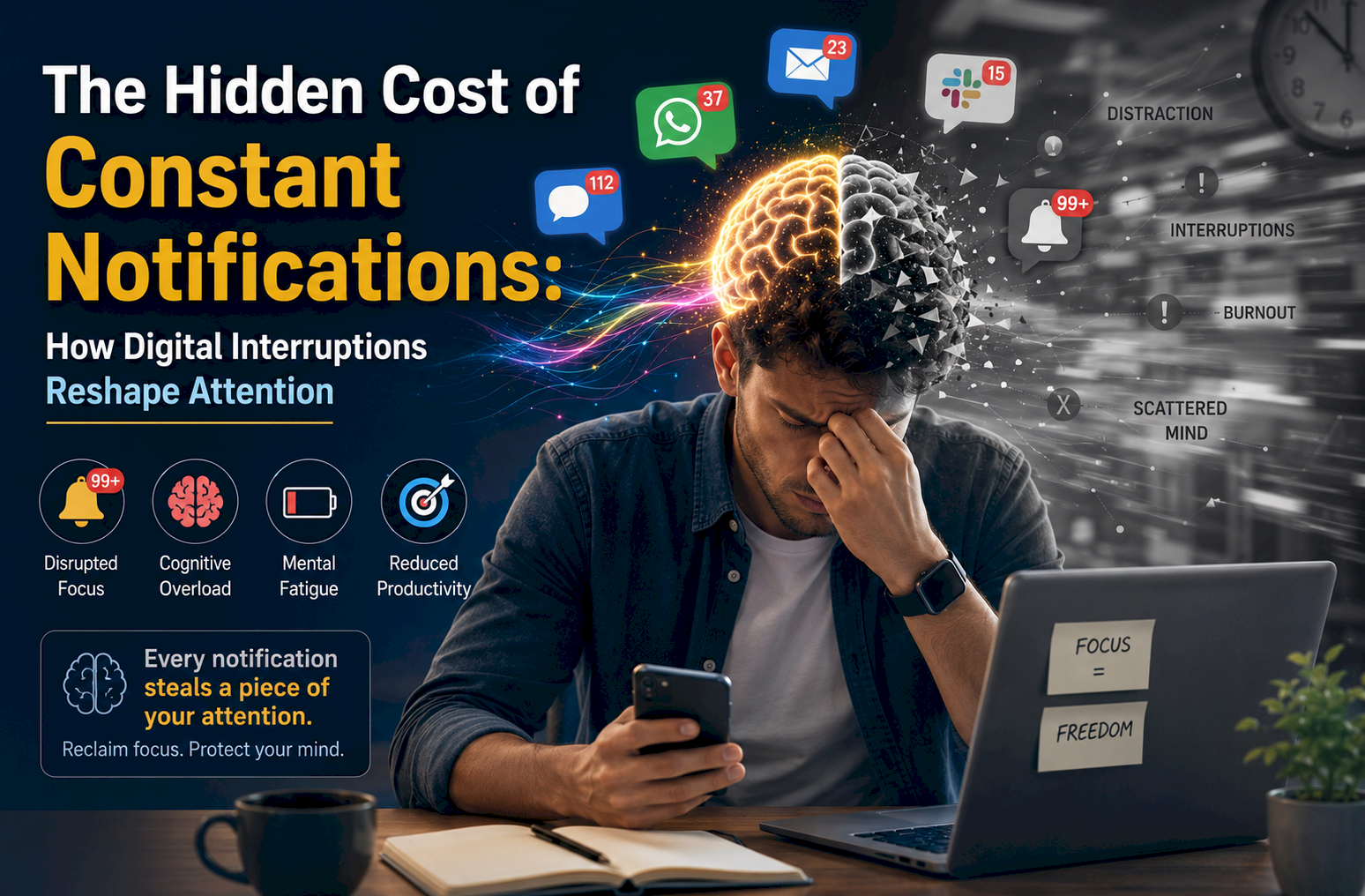
The Hidden Cost of Constant Notifications: How Digital Interruptions Reshape Attention
Notifications were originally designed to help people notice important events without repeatedly checking their devices. A message could announce an urgent email, a calendar reminder, or a missed call. Over time, however, notifications expanded into nearly every part of digital life.
Today, smartphones and computers constantly compete for attention through banners, badges, vibrations, sounds, promotional alerts, news updates, social reactions, and automated recommendations. Each interruption may appear small, but together they can significantly change the way people work, think, communicate, and rest.
From Useful Alerts to Continuous Interruption
The modern notification system rarely distinguishes clearly between what is urgent and what is merely available. A security warning may appear beside a shopping discount, while a family message may compete with a game reminder or a social media suggestion.
This creates a digital environment in which everything appears to demand immediate attention. Users may begin responding automatically, not because the information is important, but because the device has trained them to treat every alert as a potential priority.
The result is not simply inconvenience. Constant interruption can gradually weaken the ability to remain focused on one task for an extended period.
The Cost of Switching Attention
When a notification appears, the disruption does not end when the banner disappears. The mind must decide whether to ignore the alert, open it, postpone it, or remember it for later. Even a notification that is not opened can occupy mental space.
If the user does open it, attention shifts from the original task to a different context. Returning to the previous activity requires rebuilding concentration, recalling where the work stopped, and restoring the original train of thought.
This repeated switching is especially costly during activities that require deep focus, including:
- Writing and editing.
- Programming and technical work.
- Studying and reading.
- Financial planning.
- Creative design.
- Complex decision-making.
A person may technically remain busy throughout the day while accomplishing less meaningful work because so much energy is spent moving between unrelated tasks.
Why Notifications Are Difficult to Ignore
Notifications create uncertainty. Before checking an alert, the user does not know whether it contains good news, a problem, a request, or something irrelevant. This uncertainty makes the alert psychologically powerful.
Some notifications also provide small social rewards, such as a reply, a reaction, a new follower, or a positive comment. Because these rewards arrive unpredictably, users may develop the habit of checking their devices even when no alert has appeared.
Over time, the notification system can transform from a communication tool into a mechanism that continuously pulls users back into applications.
The Attention Economy Behind the Alert
Many digital platforms benefit when users return frequently, spend more time inside an application, view additional content, or interact with advertisements. Notifications therefore serve an economic purpose as well as a functional one.
An alert may not be sent because the user needs it. It may be sent because the platform wants to restore engagement. Examples include reminders about inactive accounts, suggestions to view recommended content, and alerts about activity that has little personal importance.
This creates a conflict between the interests of the user and the interests of the platform. The user may want fewer interruptions, while the application may be designed to generate more visits.
How Interruptions Affect Work
In professional environments, notifications often arrive from several systems at once. Email, workplace chat, project management platforms, calendars, shared documents, customer support tools, and mobile applications may all generate separate alerts.
This can create a culture of permanent availability. Employees may feel pressure to respond immediately, even when a message is not urgent. Fast replies can become confused with productivity, while focused work that produces long-term value becomes harder to protect.
The problem becomes more serious when teams use multiple communication channels without clear rules. The same request may appear in email, direct messages, group chats, and task-management systems, creating duplication and uncertainty.
The Emotional Impact of Always Being Reachable
Constant notifications can also affect emotional wellbeing. A device that may interrupt at any moment creates a sense of anticipation. Users may feel that there is always another message to answer, another update to review, or another issue waiting for attention.
This can make rest feel incomplete. Even during meals, conversations, exercise, or sleep, the possibility of an alert remains present. The device may be silent, but the expectation of interruption can continue.
For some users, notification badges become a visible list of unfinished obligations. The growing number of unread items can create guilt, stress, or pressure to clear them, even when many are unimportant.
Notifications Change Social Interaction
Digital interruptions do not affect only the device owner. They also influence the people nearby. A phone that repeatedly lights up during a conversation signals that another source of information may receive priority at any moment.
This can reduce the quality of face-to-face interaction, even when the phone is not actively used. The visible presence of a device may encourage partial attention, as users remain prepared to respond to something happening elsewhere.
In families, classrooms, and workplaces, this behavior can become normal. People may sit together while continuously shifting attention between the physical environment and multiple digital conversations.
Not All Notifications Have Equal Value
Eliminating every notification would not be practical. Some alerts provide real value and may be time-sensitive. Emergency warnings, security notifications, banking alerts, navigation instructions, calendar reminders, and messages from close contacts can be genuinely important.
The deeper issue is that high-value and low-value notifications often use the same channels. A critical account warning may appear with the same sound and visual style as a promotional message.
A healthier notification system would distinguish more clearly between:
- Urgent alerts requiring immediate action.
- Important information that can wait.
- Routine updates suitable for a summary.
- Promotional or engagement-driven messages.
The Rise of Notification Summaries and Focus Modes
Modern operating systems increasingly offer tools designed to reduce digital interruptions. These include scheduled notification summaries, application-level controls, focus modes, silent delivery, priority contacts, and temporary muting.
These features reflect a broader change in technology design. Device makers are beginning to recognize that providing more information is not always helpful. The timing, relevance, and frequency of information can be just as important as the content itself.
However, the effectiveness of these tools still depends on user choices. Most devices enable many notifications by default, while meaningful control often requires reviewing settings for individual applications.
Why Badges Can Be as Distracting as Sounds
Turning off notification sounds does not necessarily solve the problem. Red badges, unread counters, lock-screen previews, and flashing banners can continue to attract attention.
A badge transforms an application icon into a reminder of unfinished activity. Users may open the app simply to remove the number, only to become absorbed in additional content once inside.
This design turns the home screen into a dashboard of digital obligations. The device constantly displays what has not yet been checked, rather than supporting the task the user originally intended to complete.
The Difference Between Responsiveness and Productivity
Modern digital culture often rewards immediate responses. A person who replies quickly may appear organized and attentive. Yet constant responsiveness can come at the expense of thoughtful work.
Many valuable tasks require uninterrupted time, careful analysis, and sustained concentration. These tasks may produce fewer visible signals than rapid messaging, but their long-term value can be much greater.
Organizations that measure activity through response speed may unintentionally encourage employees to prioritize incoming messages over strategic work.
Designing Technology Around Human Attention
The future of digital wellbeing may depend on systems that understand context rather than simply delivering every alert immediately. A device could delay nonessential notifications during meetings, driving, sleep, focused work, or family time.
Artificial intelligence may also help classify notifications based on urgency and personal relevance. However, such systems would need strong privacy protections and transparent controls, especially if they analyze messages, schedules, and behavioral patterns.
The goal should not be to eliminate communication, but to deliver information at moments when it can be useful without unnecessarily fragmenting attention.
A Broader Cultural Shift
The notification problem cannot be solved entirely through settings. It also requires a cultural shift in expectations. Not every message needs an immediate reply, and not every application deserves permanent access to a user’s attention.
Workplaces can establish clearer communication rules. Families can create device-free periods. Developers can avoid unnecessary alerts. Users can become more selective about which services are allowed to interrupt them.
Attention is a limited resource. Treating it as valuable may become one of the most important digital habits of the modern era.
Conclusion
Notifications are not inherently harmful. They can provide timely information, improve security, and support communication. The problem begins when alerts become continuous, poorly prioritized, and designed primarily to increase engagement.
The true cost of constant notifications is measured not only in lost minutes, but also in fragmented thinking, reduced focus, emotional pressure, and weakened social presence.
As technology becomes more integrated into daily life, the ability to control interruptions will become increasingly important. The most useful devices may not be those that demand the most attention, but those that understand when to remain silent.