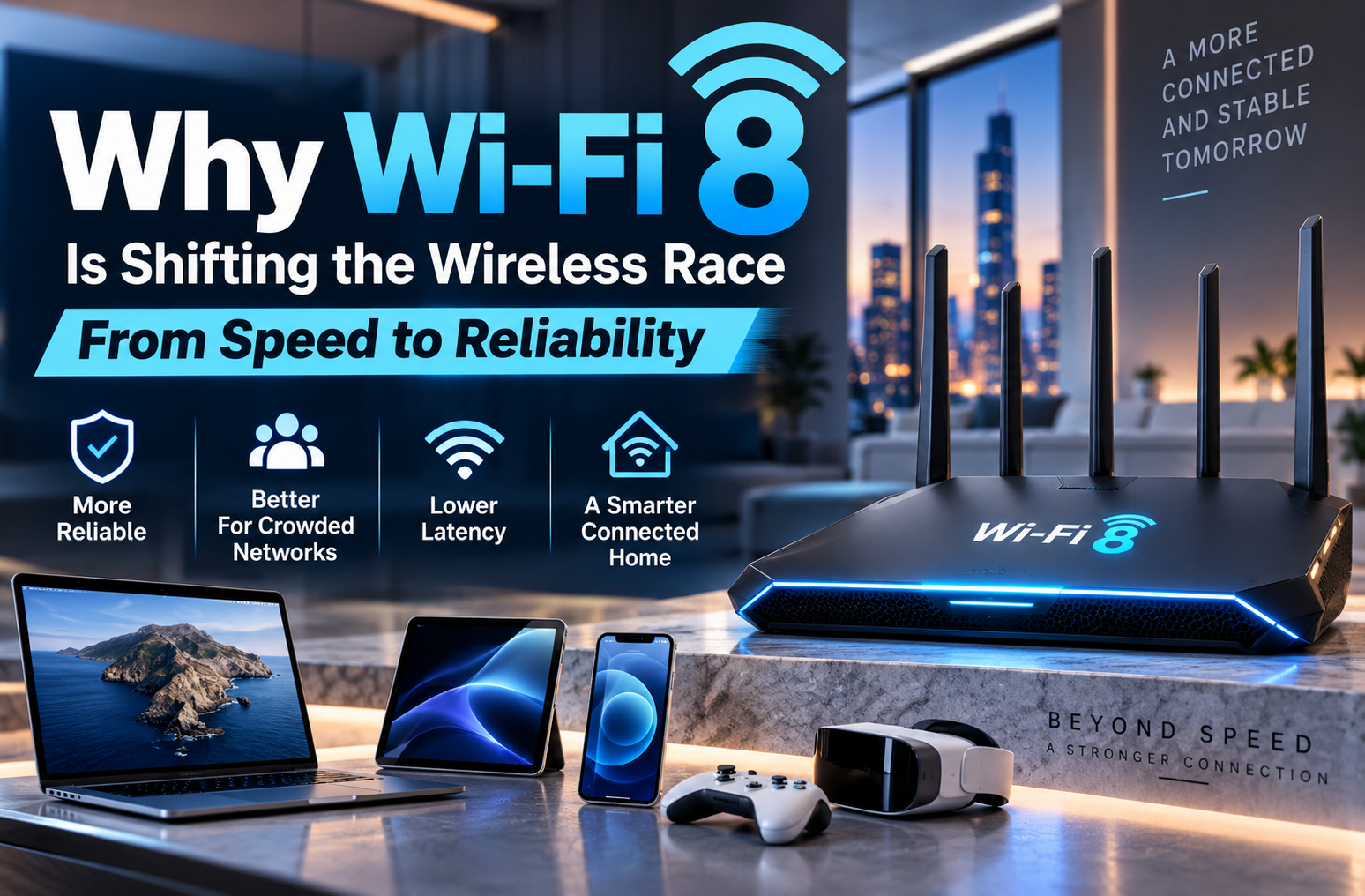
For more than a decade, every new Wi-Fi generation has been marketed around a familiar promise: more speed. Wi-Fi 8 is changing that story. Instead of chasing headline throughput alone, the next generation of wireless networking is being shaped around something users often notice more in everyday life: reliability.
Wi-Fi 8 Is About Ultra-High Reliability
Wi-Fi 8 is associated with the IEEE 802.11bn project, which is being developed around Ultra High Reliability. The goal is not simply to make peak download numbers larger. The standard work targets more consistent performance, lower latency, fewer packet losses, and better behavior when devices move between or operate around overlapping wireless networks.
That shift matters because modern homes and workplaces are increasingly crowded with phones, laptops, TVs, cameras, smart-home devices, gaming systems, and AI-enabled products. In those environments, the fastest possible connection is less useful if performance collapses when the network becomes busy.
From Peak Speed to Consistent Speed
Wi-Fi 7 already pushed wireless performance to impressive levels through technologies such as 320 MHz channels and Multi-Link Operation. Wi-Fi 8 builds on that foundation but puts more attention on keeping connections stable across distance, interference, congestion, and changing network conditions.
IEEE's current targets for the 802.11bn project include modes designed to improve throughput by at least 25% at certain signal-to-interference levels, reduce high-percentile latency by at least 25%, and reduce packet loss by at least 25% compared with the previous Extremely High Throughput generation in defined scenarios.
Why Reliability Matters More in the AI Era
Artificial intelligence is changing what connected devices do. Some AI tasks run locally, but many experiences still depend on cloud services, synchronized devices, real-time context, or continuous data exchange. That means wireless networks need to deliver more than raw bandwidth.
- Cloud gaming benefits from lower and more predictable latency.
- AI assistants can respond more consistently when connectivity remains stable.
- Video calls and live collaboration benefit from fewer dropped or delayed packets.
- Smart-home systems become more dependable when many devices communicate at once.
- Mixed-reality and spatial-computing experiences need strong performance even while users move around a space.
Hardware Is Already Preparing for Wi-Fi 8
Although the IEEE standard is still under development, the hardware ecosystem is already moving. Qualcomm introduced its FastConnect 8800 platform in 2026 with Wi-Fi 8 support and a 4x4 radio configuration. The company says the platform is designed for higher reliability, greater range, and more consistent performance in demanding environments.
Qualcomm also announced networking platforms for routers, gateways, and enterprise access points, with commercial Wi-Fi 8 products expected later in 2026. That does not mean the standard is finished, but it shows that manufacturers are already positioning products around the direction the technology is taking.
Wi-Fi 7 Will Not Become Obsolete Overnight
Wi-Fi 7 remains a major upgrade and will continue spreading across phones, PCs, routers, and consumer electronics. In fact, Wi-Fi 7 is only now becoming broadly accessible beyond premium devices. For many users, it will remain more than sufficient for years.
Wi-Fi 8 should therefore be seen as the next layer of evolution rather than a reason to replace a new Wi-Fi 7 setup immediately. Its biggest benefits are likely to appear first in dense homes, offices, gaming environments, connected-device ecosystems, and applications where consistent latency matters as much as raw speed.
The Standard Is Still Evolving
One important detail is timing. IEEE's published project timeline shows 802.11bn is still progressing through draft development, with final standardization expected later than the first wave of pre-standard or draft-aligned hardware. Buyers should therefore expect early products to evolve alongside the specification.
What This Means for Consumers
The most meaningful change with Wi-Fi 8 may be psychological as much as technical. Consumers have been trained to compare wireless generations using a single number: maximum speed. The next generation could push the market toward a broader question: how well does the network perform when conditions are difficult?
If Wi-Fi 8 delivers on its reliability goals, future wireless upgrades may be judged less by laboratory peak speeds and more by whether video calls stay smooth, gaming latency remains predictable, smart devices stay connected, and performance holds up across an entire home.
Conclusion
Wi-Fi 8 represents a shift in wireless priorities. Speed still matters, but reliability, latency, range, and consistency are becoming equally important. As connected devices and AI workloads place new demands on home and enterprise networks, the next wireless battleground may not be about who can advertise the biggest number. It may be about which network simply works better, more often, everywhere.