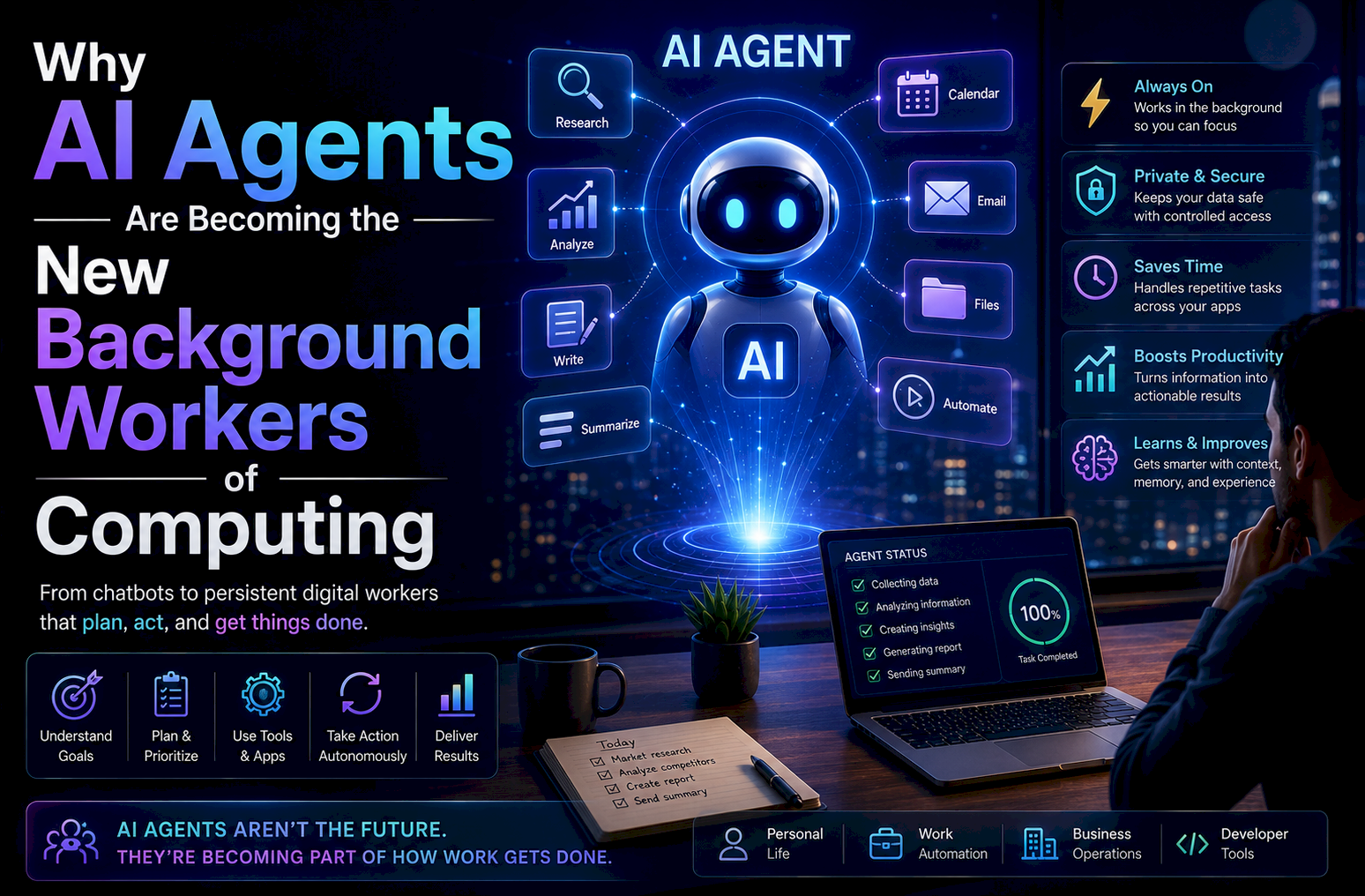
For most people, artificial intelligence first arrived as a conversation.
You opened a chatbot, typed a question, received an answer, and closed the window. The interaction was powerful, but it was temporary. The AI existed mainly when the user actively called it.
In 2026, that model is beginning to change.
The largest AI companies are increasingly building systems that can remain active across longer periods, connect to tools and applications, remember context, execute multiple steps, and continue working after the initial instruction.
Artificial intelligence is gradually moving from something people talk to into something that can work in the background.
This shift could become one of the most important changes in personal and workplace computing since the rise of mobile apps.
The Chatbot Model Has a Natural Limitation
Traditional chatbots are fundamentally reactive.
A user asks a question, the model processes the request, produces an answer, and waits for the next instruction.
That structure works extremely well for writing, brainstorming, translation, research, and many other tasks.
But it becomes inefficient when a task involves ten, twenty, or even hundreds of steps.
Consider something as simple as preparing a weekly business report.
A person might need to open several dashboards, export data, compare numbers, identify unusual changes, create charts, summarize findings, and finally format everything into a document.
A chatbot can help with individual parts of that process.
An agent can potentially handle the workflow itself.
What Makes an AI Agent Different?
An AI agent combines a model with instructions, tools, context, and some mechanism that allows it to continue taking actions toward a goal.
Instead of producing only one response, an agent can perform a sequence such as:
- Understand the objective.
- Plan the required steps.
- Choose an appropriate tool.
- Execute an action.
- Inspect the result.
- Correct mistakes if necessary.
- Continue until the task is complete.
This loop changes the role of artificial intelligence.
The model is no longer merely generating information. It is coordinating work.
2026 Is Accelerating the Transition
Several major developments during 2026 show how quickly the industry is moving toward agentic computing.
Google introduced Gemini Spark as a personal AI agent designed to proactively manage tasks across a user's digital life. The company describes Spark as capable of operating in the background while remaining under the user's direction.
Google also introduced Managed Agents for developers, allowing applications to create agents that can reason, use tools, and execute code inside isolated environments.
OpenAI, meanwhile, introduced workspace agents in ChatGPT that can automate complex organizational workflows and run in the cloud.
These developments point toward the same destination: AI systems that continue working beyond the boundaries of a single conversation.
Background Work Is the Important Part
The most significant change may not be intelligence itself.
It is persistence.
Most traditional software waits for someone to interact with it.
A background agent can potentially continue executing an approved task while the user focuses on something else.
That makes AI closer to a digital worker than a traditional application.
For example, instead of repeatedly asking an assistant to check information, a user could assign a broader goal and allow the system to manage the intermediate steps.
Computing Is Moving From Apps Toward Intent
Modern computing is organized primarily around applications.
If you want to send an email, you open an email app. If you want to edit a spreadsheet, you open a spreadsheet application. If you want to book a trip, you move between search engines, airline websites, maps, hotels, and payment services.
Agents introduce another possibility.
The user describes the desired outcome rather than selecting every application manually.
The AI then decides which services and tools are required.
This could gradually shift computing from an app-centric interface toward an intent-centric interface.
The Interface Could Become Much Simpler
A traditional workflow might require ten applications and dozens of clicks.
An agentic workflow could begin with a sentence.
The complexity does not disappear. It moves behind the interface.
The agent becomes responsible for navigating APIs, applications, files, websites, and other services while presenting the user with a simplified interaction layer.
This is one reason agentic AI has the potential to reshape operating systems as much as individual applications.
Personal Agents Need Context
A useful background worker must understand more than the immediate instruction.
It may need context about:
- The user's preferences.
- Previous decisions.
- Current projects.
- Frequently used applications.
- Calendar events.
- Documents and files.
- Communication history.
- Organizational policies.
Without this context, the user has to repeatedly explain the environment in which the task exists.
This is why memory and agents are developing together.
Memory Turns an Agent Into a Persistent Worker
Long-running AI systems need a way to preserve relevant information across sessions.
OpenAI has continued expanding memory in ChatGPT, while agent systems from multiple companies increasingly use persistent context and structured memory to preserve progress.
The combination is powerful.
An agent that remembers previous work can potentially continue a project instead of restarting from the beginning every time.
This is especially important for tasks that last days or weeks.
Long-Running Agents Are Becoming Technically Practical
One of the major engineering challenges for agents is context management.
Even large context windows eventually fill up.
An agent that works for hours cannot simply keep every observation, tool result, conversation, and file permanently inside one prompt.
Research and engineering work across the industry increasingly focuses on techniques such as summarization, compaction, selective retrieval, persistent memory, and specialized orchestration.
These methods allow an agent to preserve important information while discarding unnecessary details.
The Operating System May Become an Agent Platform
Operating systems traditionally manage applications, files, permissions, devices, and processes.
AI agents increasingly need access to exactly those resources.
This creates a strong incentive for operating-system developers to build agent capabilities directly into their platforms.
A system-level agent could potentially understand notifications, applications, documents, windows, devices, and permissions without relying on fragile workarounds.
In this model, the AI becomes a new software layer sitting above applications but below the user's intentions.
Google Is Already Moving in This Direction
Google's 2026 announcements provide a clear example of this trend.
Gemini Spark is designed as a persistent personal agent that can work across a user's digital life and integrate deeply with Google services.
Google has also expanded Gemini Intelligence on Android, adding capabilities designed to automate more complex tasks and interact with information across the device.
The important point is not any single feature.
It is the gradual integration of the AI layer with the operating environment itself.
The Same Shift Is Happening at Work
Workplace AI may adopt background agents even faster than consumer computing.
Organizations already have repetitive workflows that are relatively well structured.
Examples include:
- Preparing recurring reports.
- Monitoring dashboards.
- Processing incoming requests.
- Analyzing datasets.
- Reviewing support tickets.
- Updating internal documentation.
- Responding to routine messages.
- Running software tests.
These are ideal environments for agents because the objectives and tools are often clearly defined.
OpenAI's Workspace Agents Show the Direction
OpenAI introduced workspace agents in ChatGPT during 2026 as cloud-based agents designed to handle complex workflows for organizations.
They can be configured once, shared across teams, and improved over time.
That creates a new category between traditional software automation and human employees.
Instead of building a custom application for every workflow, teams may increasingly create specialized AI workers.
Agents Could Change How Software Is Purchased
Today companies frequently buy software because employees need access to a particular interface.
In an agentic environment, the interface may matter less.
What matters is whether an agent can access the capability through an API, protocol, or approved tool.
This could change software economics.
Some products may increasingly serve AI agents as customers or intermediaries rather than human users directly.
APIs May Become More Important Than Interfaces
If agents interact directly with services, well-designed APIs become extremely valuable.
A service that requires complicated manual navigation may be difficult for an agent to use reliably.
A service with structured actions, clear permissions, and predictable outputs is much easier to integrate into automated workflows.
This could encourage software companies to design products for both humans and AI systems.
Open Standards Could Become Critical
Agents need standardized ways to discover and use external tools.
This is one reason protocols for connecting models to tools and data sources are receiving growing attention.
Anthropic created the Model Context Protocol as an open standard for connecting AI systems with external data and tools, and the protocol was later contributed to the Linux Foundation's Agentic AI Foundation.
The broader idea is significant.
Agents become more useful when developers do not need to build a completely different integration for every AI platform.
Background Agents Create New Security Problems
The more actions an agent can perform, the greater the consequences of a mistake.
A chatbot that produces an incorrect answer can be corrected.
An agent that sends a message, deletes a file, purchases a product, changes production code, or transfers sensitive data can create much larger problems.
Agentic systems therefore require security mechanisms beyond traditional chatbot safeguards.
Permissions Will Become a Core Design Problem
A useful agent needs access to resources.
A secure agent should receive only the minimum access required.
That creates a constant tension between capability and safety.
Developers will increasingly need to determine:
- Which tools an agent can use.
- Which files it can read.
- Which applications it can control.
- Which actions require confirmation.
- How long permissions remain active.
- How agent activity is logged.
These controls may eventually become as familiar as mobile app permissions are today.
Confirmation Before Major Actions May Become Standard
Google says Gemini Spark is designed to check with users before taking major actions.
That principle is likely to become common across agent platforms.
Not every step requires human approval.
Requiring confirmation for every action would eliminate much of the value of automation.
The challenge is determining which actions are important enough to interrupt the user.
The Human Role Moves Toward Supervision
As agents become capable of handling more intermediate steps, people may spend less time executing repetitive actions manually.
Their role increasingly becomes:
- Defining objectives.
- Providing constraints.
- Reviewing important decisions.
- Evaluating results.
- Correcting failures.
This resembles the relationship between a manager and a junior worker more than the relationship between a user and traditional software.
Multiple Agents May Work Together
A single agent does not necessarily need to perform every part of a complicated task.
Some systems are experimenting with multiple specialized agents.
One agent might conduct research, another analyze data, another write code, and another verify the final output.
A coordinating agent can distribute tasks and combine the results.
This approach resembles a small digital team.
Parallel Agents Could Change Knowledge Work
Human workers are limited by attention.
One person cannot normally investigate twenty independent questions simultaneously.
Software agents can potentially run many tasks in parallel.
This changes the economics of research, coding, analysis, and operations.
Instead of deciding which task deserves attention first, a user may eventually delegate several tasks at once and review the results later.
Agent Speed Is Not the Only Metric That Matters
An extremely fast agent that frequently makes mistakes is not necessarily useful.
Background workers need reliability.
Important measurements may include:
- Task completion rate.
- Accuracy across long workflows.
- Ability to recover from errors.
- Cost per completed task.
- Number of unnecessary actions.
- Human intervention required.
These metrics are different from traditional AI benchmarks that evaluate one isolated answer at a time.
Agent Evaluation Is Becoming Its Own Discipline
Evaluating an agent is significantly more complicated than evaluating a chatbot.
The system may use tools differently on every attempt.
It might reach the correct outcome using a completely different sequence of actions.
Real-world environments can also change during the task.
As agents become more important, testing their behavior across realistic workflows will become a major engineering challenge.
The Cost Structure of AI Could Change
Traditional chatbot usage is often measured in individual requests or tokens.
Background agents may consume computing resources continuously across many steps.
That creates new questions about cost.
A task that takes an agent one hour and hundreds of tool calls could be significantly more expensive than a short conversation.
Companies will therefore need systems that decide when to use powerful models and when smaller, cheaper models are sufficient.
Smaller Models May Become Important Background Workers
The most advanced model is not always required for every agent step.
Simple actions such as classifying information, checking formatting, extracting fields, or routing tasks can often be performed by smaller models.
A sophisticated agent platform could dynamically combine several models.
Powerful reasoning models might handle difficult decisions, while efficient models perform routine work.
This architecture could significantly reduce cost and latency.
Personal AI Could Become Invisible
One of the most interesting consequences of background agents is that users may interact with AI less visibly even while relying on it more.
Today artificial intelligence usually appears as a dedicated chatbot interface.
Tomorrow, an agent may quietly prepare information before a meeting, organize files, summarize notifications, monitor ongoing tasks, or coordinate applications.
The user may see only the result.
AI could become more important precisely as the AI interface becomes less visible.
This Is Similar to What Happened With Cloud Computing
Cloud computing was once marketed as a distinct technology.
Today people use cloud infrastructure constantly without thinking about it.
AI may follow a similar path.
Instead of opening a dedicated AI application for every task, intelligence could become embedded throughout the operating environment.
Agents would simply become part of how computing works.
The Biggest Competition May Shift Away From Model Benchmarks
As frontier models become increasingly capable, differences in raw intelligence may matter less for everyday users.
The more important questions could become:
- Which agent has access to the best tools?
- Which one understands the user's context?
- Which platform has the strongest integrations?
- Which agent can work reliably for long periods?
- Which system gives users the best control?
- Which one can complete tasks at the lowest cost?
This could shift competition from models toward complete agent ecosystems.
The Companies That Control the Agent Layer Gain Enormous Influence
If users begin asking an agent to choose services, research products, organize information, and execute actions, the agent becomes an important intermediary between people and the internet.
That position is strategically valuable.
The system may influence which applications people use, which services they discover, and how information is presented.
For this reason, the agent layer could become one of the most competitive areas in technology.
Trust May Matter More Than Intelligence
People tolerate occasional mistakes from a chatbot because they remain in control.
The threshold changes when software begins acting independently.
Users must trust that the system will understand the objective, respect limits, protect sensitive information, and avoid irreversible mistakes.
That means the most successful agent may not be the one with the highest benchmark score.
It may be the one users are comfortable allowing to act on their behalf.
2026 Looks Like the Beginning, Not the End
The agent systems appearing in 2026 are still early.
They can fail, misunderstand instructions, struggle with long workflows, or require supervision.
But the direction is becoming increasingly clear.
Google is developing persistent personal agents. OpenAI is building workplace agents. Developers are gaining managed agent platforms. The industry is building open standards for tool access, memory systems for continuity, and new techniques for long-running tasks.
These components are beginning to form a new computing layer.
Conclusion
The first generation of generative AI was defined by conversation.
The next generation may be defined by delegation.
Instead of asking artificial intelligence to explain every step, users will increasingly assign objectives and allow agents to perform much of the intermediate work.
This transition requires more than smarter models. It requires memory, tools, permissions, security, orchestration, monitoring, and reliable long-running execution.
As those pieces mature, AI could become less like an application that waits to be opened and more like a persistent background workforce integrated into personal and professional computing.
The most important AI assistant of the future may therefore be the one you interact with the least — because much of its value will come from the work it completes while you are doing something else.
Official sources: Google Gemini, OpenAI, Anthropic.