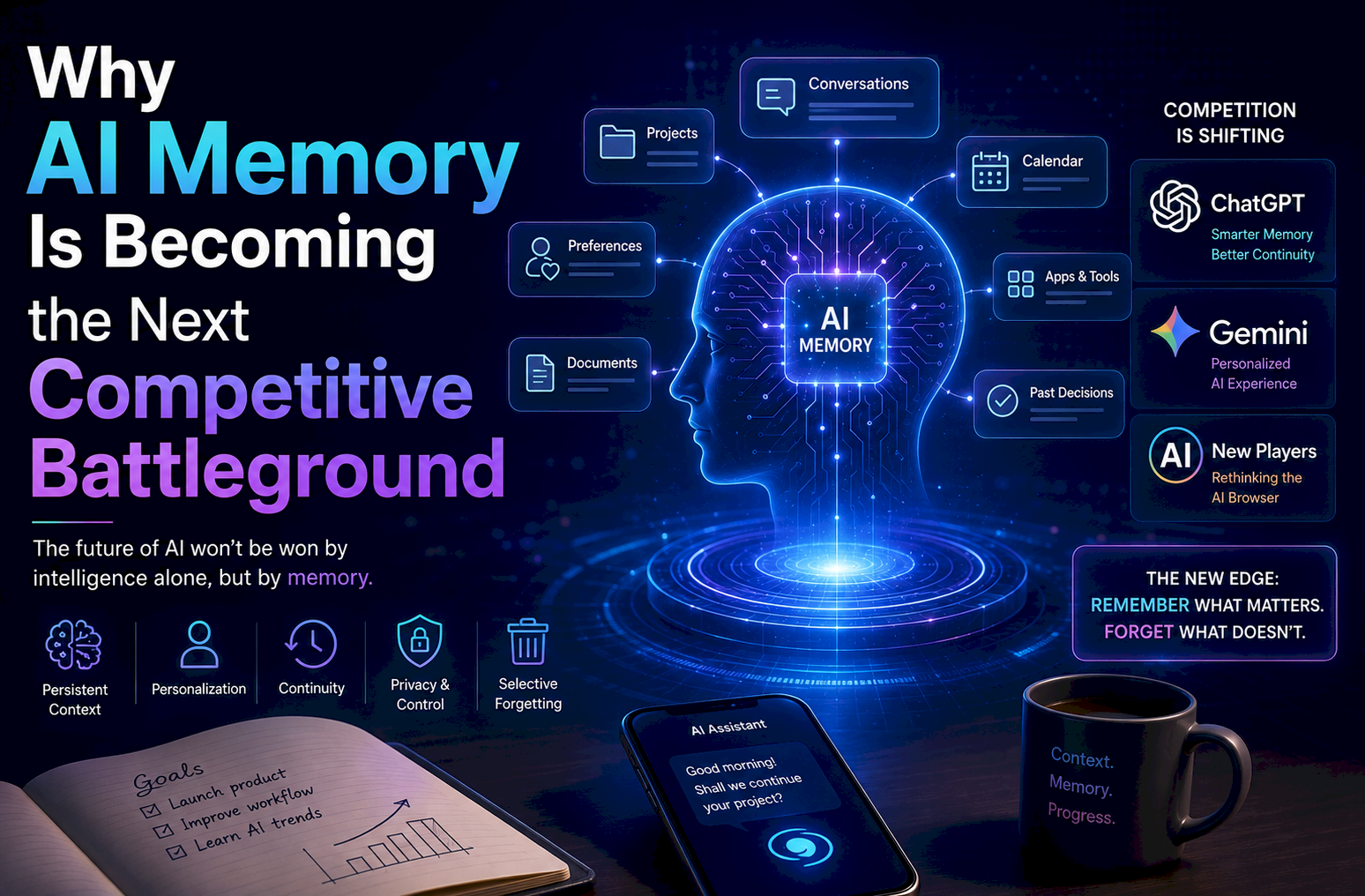
For most of the generative AI era, competition has been measured through model intelligence. Companies compared reasoning scores, coding performance, context windows, multimodal capabilities, speed, and price. In 2026, however, another factor is becoming increasingly important: memory.
An AI assistant that can generate an impressive answer is useful. An assistant that understands what a user is working on, remembers relevant preferences, recognizes changes over time, and continues a project without requiring the same explanation again can become something much more valuable.
This is why memory is evolving from a convenient chatbot feature into a strategic layer of artificial intelligence. The next major competition between AI platforms may not simply be about which model knows more, but which system can remember the right information, retrieve it at the right moment, update it when circumstances change, and forget it when the user wants it gone.
AI Assistants Have Traditionally Started From Scratch
One of the strangest characteristics of early AI assistants was how quickly they could appear to understand a user while simultaneously knowing almost nothing about them in the next conversation.
A person could spend an hour explaining a project, business, writing style, technical environment, or personal preference. The AI might perform exceptionally well during that session, but much of the context could disappear when a new conversation began.
This created a fundamental limitation for products marketed as assistants. Real assistants do not normally need to be reintroduced to the same project every morning.
Persistent memory is designed to reduce that friction.
OpenAI Is Treating Memory as a Core Part of ChatGPT
A significant signal arrived in June 2026 when OpenAI introduced a more capable memory system for ChatGPT designed to improve freshness, continuity, and relevance.
Instead of relying only on a collection of manually saved facts, the newer approach is designed to continuously synthesize useful context and reduce problems caused by outdated or contradictory memories.
This matters because long-term personalization becomes increasingly difficult as an assistant interacts with the same person for months or years.
A preference that was accurate last year may no longer be relevant. A temporary project can end. A user may change jobs, devices, routines, priorities, or goals.
Simply accumulating information indefinitely is therefore not enough. A useful memory system must understand that personal context changes.
Google Is Moving Toward Similar Personalization
Google has also been expanding personalization capabilities around Gemini.
Features that allow Gemini to use information from previous conversations demonstrate the same broader industry direction: assistants are expected to provide responses based not only on the current prompt but also on useful historical context.
This creates a very different user experience.
Instead of saying, "I prefer concise summaries, I work on this project, these are my priorities, and this is what we discussed yesterday," the user can increasingly expect the assistant to maintain continuity automatically.
Memory Changes the Value of the AI Model
Imagine two AI models with almost identical reasoning performance.
The first receives only the current prompt.
The second understands the user's preferences, previous decisions, active projects, commonly used tools, recurring tasks, and relevant past conversations.
Even if their raw intelligence is similar, the second assistant may feel dramatically more capable because it begins every interaction with better context.
This illustrates why benchmark scores alone cannot fully measure the usefulness of future AI assistants.
Context Is Becoming Infrastructure
The AI industry increasingly treats context as something that must be managed rather than simply placed inside a large prompt.
A modern assistant may potentially have access to enormous amounts of information:
- Previous conversations.
- Documents and uploaded files.
- Project history.
- Preferences and instructions.
- Connected applications.
- Calendar information.
- Email and communication history.
- Completed tasks.
- Corrections made by the user.
Loading all of this into every request would be inefficient and potentially harmful to accuracy.
The important challenge is therefore selective retrieval: identifying which pieces of past information actually matter for the current task.
Good Memory Is Not the Same as Perfect Recall
It may seem logical that the best AI assistant would remember everything. In practice, perfect recall could create significant problems.
Human lives contain contradictions, temporary situations, abandoned ideas, mistakes, jokes, outdated preferences, and information that should no longer influence future decisions.
An assistant that remembers everything without understanding relevance could become less useful over time.
The challenge is not maximum memory. It is useful memory.
Forgetting May Become an AI Feature
This leads to one of the most interesting ideas in personal AI: forgetting may eventually be just as important as remembering.
An intelligent memory system needs mechanisms for deciding when information should lose importance, when newer information should replace older information, and when data should be removed entirely.
For example, consider a user who tells an assistant:
"I am preparing to move to London."
For several months, that information could be extremely relevant. It may affect travel recommendations, housing research, budgeting, and scheduling.
Two years later, however, continuing to treat the move as an active plan could produce incorrect recommendations.
Memory must therefore evolve rather than simply accumulate.
Contradictions Are a Difficult Technical Problem
Long-term memory also creates a challenge that short conversations rarely expose: people regularly change their minds.
A user might initially prefer one tool and later switch to another. They may abandon a project, change their preferred writing style, purchase a different device, or adopt a new workflow.
A naive memory system could preserve both statements and retrieve the wrong one.
More advanced systems need to recognize that some memories supersede others and that recency can matter differently depending on the type of information.
This is one reason memory management itself is becoming an important area of AI research.
AI Agents Make Memory Even More Important
Memory becomes especially valuable when AI moves from conversation toward autonomous or semi-autonomous agents.
A chatbot can survive occasional context loss because the user can explain the question again.
An AI agent working on a project over several days may need continuity to avoid repeating work or making inconsistent decisions.
A coding agent, for example, may need to remember:
- Architecture decisions.
- Previous bugs.
- Project constraints.
- Libraries already selected.
- Rejected approaches.
- Security requirements.
- Tasks that have already been completed.
Without reliable memory, autonomous systems risk repeatedly rediscovering the same information.
Personal AI Raises a Much Bigger Privacy Question
The benefits of memory are obvious, but so are the privacy implications.
The more useful an assistant becomes, the more potentially sensitive context it may accumulate.
A long-term assistant could theoretically understand more about a person's habits, projects, relationships, preferences, work, and routines than almost any individual application.
This makes memory governance a critical product requirement rather than an optional privacy feature.
Users Need Visibility Into What AI Remembers
For persistent memory to become trustworthy, users need understandable controls.
At minimum, a mature system should make it possible to understand:
- What information is being remembered.
- Where that information came from.
- Why it influenced a response.
- How to correct inaccurate information.
- How to remove information.
- How to disable memory when desired.
OpenAI's newer ChatGPT memory controls illustrate this direction by providing users with a memory summary and tools for reviewing or modifying remembered information.
Transparency will become increasingly important as memory systems grow more sophisticated.
Memory Could Become a Platform Lock-In Advantage
There is also a major business implication.
If an AI assistant understands a user deeply after years of interaction, moving to a competing assistant could become inconvenient.
The new service might have an equally powerful model but lack years of accumulated context.
This creates the possibility of a new form of platform lock-in based not on files or purchased applications, but on personalized AI context.
Companies may therefore eventually face pressure to make AI memory portable in the same way users increasingly expect portability for contacts, photos, documents, and other personal data.
Could Users Eventually Own Their AI Memory?
One possible future is a personal memory layer that exists independently from any single AI provider.
Instead of ChatGPT, Gemini, Claude, or another assistant each maintaining completely separate versions of the user, a secure personal memory system could theoretically provide approved context to whichever AI service the user chooses.
The user would control the memory, while models become interchangeable intelligence layers that temporarily access it.
This architecture could create a radically different competitive environment.
Instead of asking which company knows the user best, the question could become which model can make the best use of user-controlled context.
On-Device Memory Could Become Increasingly Important
Privacy concerns may also encourage more AI memory processing to happen locally on personal devices.
Some information could remain encrypted or stored locally, with only relevant context being made available to cloud models when necessary.
Research into private and on-device AI memory systems is already exploring ways to preserve personalization while reducing exposure of sensitive information.
As phones and computers gain more capable neural hardware, local memory management could become an important part of the personal AI architecture.
Memory Could Make Smaller Models More Useful
An interesting consequence of better memory is that the most useful assistant may not always require the largest available AI model.
A smaller model with excellent personal context could outperform a more powerful model on routine personal tasks because it already understands the environment in which the request exists.
This could matter significantly for cost and latency.
Instead of sending every request to the most expensive reasoning model, an AI platform could combine efficient models with strong memory systems and escalate only difficult tasks to larger models.
The Best Assistant May Know What Not to Retrieve
More information does not automatically create better answers.
Retrieving irrelevant memories can distract the model, increase processing costs, and introduce incorrect assumptions.
A high-quality memory system therefore needs to make several decisions before answering:
- Is past information relevant?
- Is it still current?
- Is the source reliable?
- Does the user still want it remembered?
- Could using it create a privacy or safety problem?
These decisions could become a major differentiator between AI platforms.
Memory Makes AI Feel Less Like Software
Persistent context also changes the psychological experience of using artificial intelligence.
Traditional software usually reacts to commands without building a meaningful understanding of the person using it.
An assistant that remembers ongoing projects and previous decisions creates a stronger sense of continuity.
This is one reason memory can make AI systems feel dramatically more personal even when the underlying model has not changed.
The assistant appears to understand not only the current question but also the story surrounding it.
The Competitive Advantage Could Shift From Models to Relationships
As frontier models become closer in capability, personalization may become a more visible source of differentiation.
Users may choose an AI platform not because it leads every benchmark, but because it already understands how they work.
That could transform the AI market.
Instead of competing only through model releases, companies may increasingly compete through the quality of the long-term relationship their assistants can maintain with users.
2026 Is Showing What Comes After the Chatbot
The evolution of memory fits into a broader transition across the AI industry.
Chatbots are gradually becoming assistants. Assistants are becoming agents. Agents are beginning to interact with tools, applications, files, and services across longer periods of time.
Every step in that progression increases the importance of continuity.
An intelligent system that acts over time needs some reliable way to understand what happened before.
Conclusion
The next major AI competition may not be won by the model with the longest context window or the highest benchmark score.
It may be won by the platform that builds the best memory system around its models.
Useful AI memory must do far more than store old conversations. It needs to identify important information, keep it current, resolve contradictions, preserve privacy, retrieve context selectively, support user corrections, and forget information when appropriate.
As AI assistants become more personal and agents become more autonomous, these capabilities will increasingly determine whether an AI system feels like a temporary tool or a persistent digital partner.
In that sense, memory is becoming more than an AI feature. It is becoming part of the infrastructure that could define the next generation of personal computing.