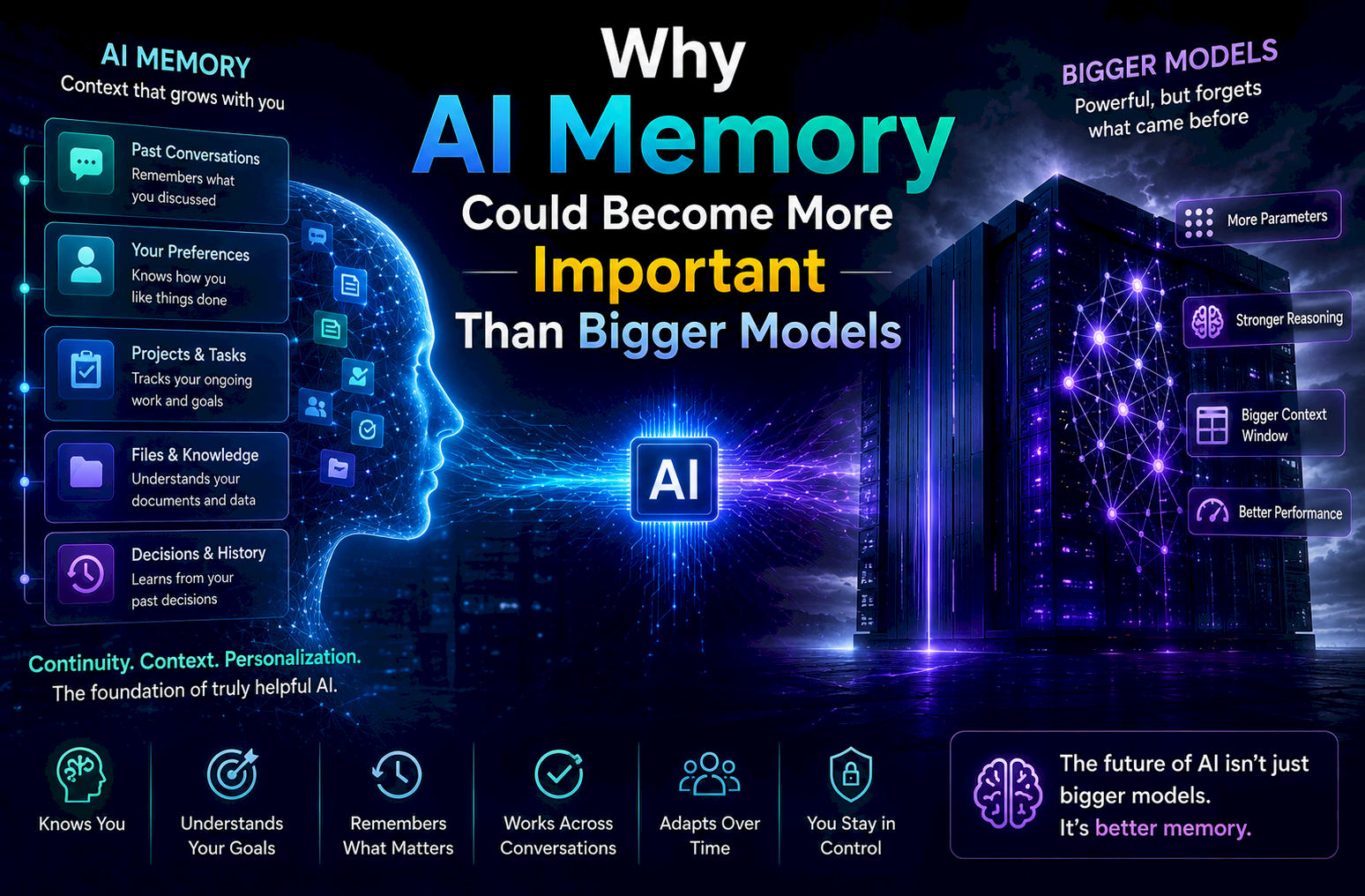
For the past several years, the artificial intelligence industry has been obsessed with scale. New models arrive with stronger reasoning, better coding abilities, larger context windows, multimodal capabilities, and increasingly sophisticated tools.
Yet one of the most important changes in AI may have less to do with making models dramatically larger and more to do with something surprisingly familiar: memory.
An assistant that can solve an extremely difficult problem is impressive. An assistant that remembers how you work, understands your preferences, keeps track of unfinished tasks, and continues projects across multiple conversations could ultimately be much more useful in everyday life.
This is why persistent memory is becoming an important layer in the evolution from AI chatbots toward personal assistants and autonomous agents.
The Original Chatbot Problem: Every Conversation Started Over
Early generative AI assistants largely treated conversations as isolated sessions.
A user could spend considerable time explaining a project, preferred writing style, business context, technical environment, or personal workflow. Starting another conversation often meant providing much of that information again.
This created an unusual experience. The AI could explain advanced mathematics or generate sophisticated software, yet it might know almost nothing about a user who had interacted with it repeatedly.
Persistent memory attempts to solve that mismatch.
Context and Memory Are Not the Same Thing
It is easy to confuse a large context window with long-term memory, but the concepts solve different problems.
A context window determines how much information a model can consider during a particular interaction or task. Increasing it allows the system to work with larger documents, longer conversations, bigger codebases, and more supporting material.
Memory addresses a different question: what information should remain useful after the immediate conversation ends?
A model could theoretically support an enormous context window while still requiring the user to provide the relevant information again during a future session.
Persistent Memory Changes the Relationship With AI
When an AI system remembers useful information across conversations, the interaction begins to resemble an ongoing working relationship rather than a sequence of disconnected questions.
For example, a persistent assistant could remember:
- The type of work a user regularly performs.
- Preferred writing or communication styles.
- Frequently used software and platforms.
- Important projects and their current status.
- Formatting preferences.
- Recurring tasks and workflows.
- Previous decisions relevant to future work.
The user no longer needs to rebuild the same context every time.
Memory Could Make Smaller Models More Useful
The AI industry frequently compares models using benchmarks designed to measure reasoning, coding, mathematics, knowledge, or other capabilities.
But everyday usefulness depends on more than raw intelligence.
Imagine two assistants. One is slightly more capable on difficult reasoning benchmarks but knows nothing about the user. The other is slightly less powerful but understands the user's projects, preferences, terminology, and previous decisions.
For many routine tasks, the second assistant could produce the more useful result.
This suggests that improvements in memory and personalization may sometimes deliver greater practical value than another incremental increase in benchmark performance.
Memory Becomes Even More Important for AI Agents
The rise of AI agents makes persistent context significantly more valuable.
Traditional chatbots generally operate through a simple interaction: the user asks a question and the model generates an answer.
Agents are designed around goals. They may search for information, analyze files, use software tools, interact with services, and execute multiple steps before completing a task.
Long-running work requires continuity.
An agent that forgets previous decisions or repeatedly asks for information it has already received becomes inefficient very quickly.
Projects Rarely Fit Into One Conversation
Real work often unfolds over days, weeks, or months.
A developer might gradually build an application. A researcher may collect sources over several weeks. A content creator may operate an ongoing publishing workflow. A business team may continuously update a product strategy.
These activities naturally generate history.
An AI assistant becomes more valuable when it can understand where the project currently stands rather than treating every interaction as the beginning of a new project.
The Industry Is Moving Toward Persistent AI
Major AI companies are increasingly experimenting with systems that retain useful information between conversations.
OpenAI has expanded memory capabilities in ChatGPT over time, allowing the product to use relevant information from previous interactions to personalize future responses.
Google has also developed personalization capabilities around Gemini and its broader ecosystem, while Anthropic has introduced memory-oriented features for Claude users and teams.
The implementations differ, but the direction is similar: AI assistants are becoming less session-based.
The Real Opportunity Is Selective Memory
A useful AI system should not simply remember everything.
Most conversations contain information that will never matter again. Saving every sentence indefinitely could create enormous amounts of irrelevant context.
The harder problem is deciding what deserves to be remembered.
An effective memory system needs to identify information that is likely to improve future interactions while ignoring temporary details.
That makes AI memory partly a retrieval problem and partly a judgment problem.
Memory Needs Different Time Scales
Human memory is not a single database, and useful AI memory may eventually operate in a similar layered fashion.
Some information is relevant for only a few minutes. Other information matters throughout a project. Certain preferences may remain useful for years.
Future assistants could therefore maintain several forms of memory:
- Working memory: information needed for the current task.
- Project memory: decisions, files, goals, and context associated with an ongoing project.
- Preference memory: stable information about how the user prefers to work.
- Relationship memory: important people, organizations, or recurring collaborators.
- Historical memory: previous actions and decisions that may become relevant later.
Managing these layers intelligently could become an important competitive advantage.
AI Could Build a Personal Knowledge Graph
One possible evolution is the creation of a continuously updated personal knowledge graph.
Instead of storing isolated facts, the system could understand relationships between information.
It might know that a particular document belongs to a certain project, that the project involves specific collaborators, that a meeting resulted in a decision, and that the decision affects a task scheduled for later.
This would allow the assistant to retrieve context based on relationships rather than simple keyword matching.
Search Becomes Personal Retrieval
Traditional search engines retrieve information from the public web.
A persistent AI assistant may increasingly retrieve information from a combination of the public internet and the user's own digital history.
A future request could implicitly search across emails, documents, previous conversations, calendar events, notes, and project records—assuming the user has explicitly granted access.
The answer would therefore depend not only on what exists online but also on what the system knows about the user's current situation.
Personalization Could Become More Valuable Than Model Switching
Today, users often compare AI systems based on which model performs best on a particular benchmark or task.
Persistent memory could create a different kind of loyalty.
If an assistant has accumulated months or years of useful context about a user's workflows, moving to another platform could mean losing part of that personalized environment.
This creates a potential competitive moat that has little to do with the underlying model itself.
Memory Could Become a New Platform Lock-In
Technology platforms have historically created ecosystems through applications, files, subscriptions, and cloud services.
AI introduces another possibility: accumulated context.
A highly personalized assistant may know how a company operates, how an individual writes, which projects matter, and how recurring workflows are performed.
That information could make switching services inconvenient unless memory becomes portable.
This raises an important future question: should users be able to export their AI memory and move it between assistants?
Portable AI Memory Could Become an Important Standard
If AI assistants become fundamental productivity tools, users may eventually expect memory portability in the same way they expect to export contacts, files, or calendars.
A standardized memory format could allow someone to move preferences and project context from one AI platform to another.
Without portability, memory could become one of the strongest forms of ecosystem lock-in in the software industry.
Privacy Is the Biggest Challenge
The usefulness of persistent memory creates an obvious tension.
The more an assistant knows, the more personalized and effective it can become. But the same information may also be sensitive.
A long-term AI memory could potentially contain information about work projects, relationships, financial preferences, schedules, communications, and personal routines.
Users therefore need strong control over what is stored and how it is used.
Users Need to See What the AI Remembers
A memory system should not operate as an invisible black box.
People should be able to inspect important stored information, correct inaccurate memories, remove individual items, and disable memory when appropriate.
This is especially important because models can misunderstand context.
If an incorrect assumption becomes persistent, it could influence many future responses.
Forgetting Is a Feature, Not a Failure
A sophisticated memory system also needs the ability to forget.
Preferences change. Projects end. People switch jobs. Software environments are replaced. Temporary circumstances become irrelevant.
Keeping outdated information forever could gradually make an assistant less useful.
Future memory systems may therefore need expiration mechanisms that reduce the importance of information over time unless it continues to be relevant.
Memory Requires Confidence
Not every piece of information should be treated with equal certainty.
If a user explicitly states a stable preference several times, the system may have high confidence that it remains useful.
If the assistant infers something from a single ambiguous conversation, that memory should probably carry much lower confidence.
Tracking certainty could prevent assumptions from turning into permanent facts.
Shared Memory Could Transform Team AI
Memory becomes even more interesting inside organizations.
A company AI assistant could potentially maintain context about projects, documentation, decisions, policies, and workflows that are distributed across many systems.
Instead of asking individual employees to repeatedly explain organizational context, the assistant could retrieve approved knowledge automatically.
This could make AI particularly valuable for onboarding new employees and preserving institutional knowledge.
Institutional Memory Is a Massive Opportunity
Organizations constantly lose context.
Employees leave, projects change ownership, meetings are forgotten, and important decisions disappear inside old messages or documents.
AI systems capable of maintaining structured organizational memory could reduce that information loss.
A future assistant might answer not only what a company decided but also when the decision was made, what evidence supported it, and which documents were involved.
Permissions Become Critical in Shared Memory
Organizational memory introduces serious access-control challenges.
An assistant should not expose confidential information simply because it exists somewhere in company storage.
AI memory therefore needs to respect the same permissions that govern the underlying documents, messages, and systems.
As agents gain access to more workplace tools, permission-aware retrieval will become essential.
Memory Could Improve Proactive Assistants
Most AI interactions today begin when the user asks for something.
Persistent memory creates the possibility of assistants that recognize relevant situations proactively.
For example, an assistant might notice that a deadline is approaching for a project discussed earlier, identify that a required document is still incomplete, and surface that information at the appropriate moment.
This represents a major transition from reactive AI toward systems that can anticipate useful actions.
But Proactive AI Can Easily Become Annoying
There is a narrow line between helpful anticipation and constant interruption.
An assistant that remembers everything but repeatedly surfaces irrelevant reminders would quickly become frustrating.
The challenge is not simply knowing information. It is understanding when that information becomes relevant.
Good memory therefore requires good timing.
Memory Could Reduce Prompt Engineering
Much of today's AI usage involves repeatedly explaining how the model should respond.
Users specify preferred formats, tones, constraints, tools, and workflows through prompts.
Persistent memory can gradually reduce this repetition.
Instead of describing the same preferences every time, the assistant can apply previously established conventions when they are relevant.
This could make AI easier for ordinary users who have no interest in learning sophisticated prompting techniques.
The Best AI May Feel Less Like a Model
As memory improves, users may care less about which specific model is running underneath the interface.
The experience could instead be defined by continuity.
The assistant knows the project, remembers previous decisions, has access to the correct tools, understands the user's preferences, and can retrieve relevant information when needed.
At that point, the underlying model becomes one component of a much larger system.
Models May Become Interchangeable
AI platforms may eventually route different tasks to different models.
A fast model could handle simple requests, a reasoning model could solve difficult problems, and a specialized coding model could work on software.
If memory exists above the model layer, users could maintain continuity even while the platform changes which model performs each task.
This would make persistent context one of the most important pieces of infrastructure in an AI operating system.
Memory Could Be the Foundation of Personal AI
The idea of a truly personal AI assistant requires more than intelligence.
It requires continuity.
Without memory, every interaction remains temporary. With carefully managed memory, the assistant can gradually adapt to the individual using it.
The result could be a system that becomes more useful over time even if the underlying model remains unchanged.
What Will Determine the Winners?
The strongest AI memory systems will likely need to balance several competing requirements.
- Remember enough information to provide useful personalization.
- Retrieve only the memories relevant to the current task.
- Allow users to inspect and correct stored information.
- Forget outdated context when necessary.
- Respect permissions across connected services.
- Protect sensitive personal and organizational data.
- Transfer useful context between models and devices.
- Avoid allowing incorrect assumptions to become permanent.
Solving these problems may be as important as increasing raw model intelligence.
Memory May Change How We Measure AI Progress
AI progress is currently discussed through model releases and benchmark scores.
But a mature personal assistant may need a different evaluation framework.
We may eventually ask questions such as: Does the assistant understand the user's ongoing projects? Does it retrieve the correct previous decision? Does it know when a memory is outdated? Can it preserve context across months without becoming confused?
These capabilities are difficult to summarize with a single benchmark number, yet they could determine whether people trust AI with increasingly important work.
The Next AI Race Could Be About Continuity
Model intelligence will continue improving, and larger or more efficient architectures will remain important.
However, the difference between competing assistants may increasingly come from everything surrounding the model.
Memory, tools, integrations, permissions, retrieval, personalization, and agent capabilities together determine whether an AI system can become part of a user's daily workflow.
This creates a different kind of competition from the race to produce the highest benchmark score.
Conclusion
Artificial intelligence does not become truly personal simply by becoming smarter.
It becomes personal when it understands context that matters to the individual and can preserve that understanding over time.
Persistent memory could therefore become one of the defining technologies of the next generation of AI assistants and agents.
The most useful system may not always be the one with the largest model or the highest benchmark score. It may be the assistant that remembers the right things, forgets the irrelevant ones, understands how they relate, and retrieves them at exactly the right moment.
If that happens, the future of AI competition will not only be about building smarter models. It will also be about building systems that develop continuity with the people who use them.