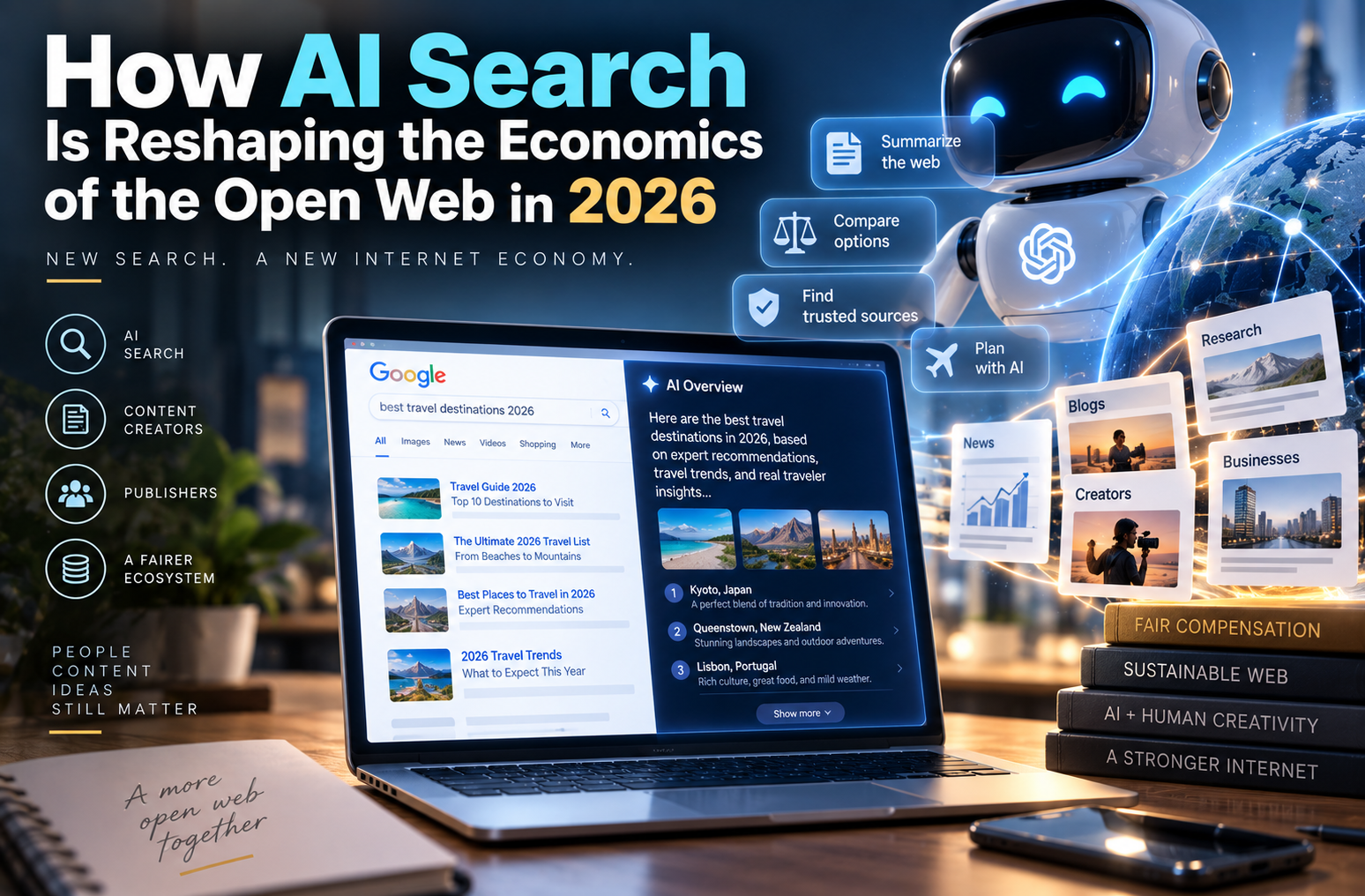
Search is changing from a system that points people toward websites into one that increasingly answers questions before a click ever happens. In 2026, that shift is no longer experimental. AI-generated answers are embedded across major search products, AI assistants are becoming a common entry point to the web, and publishers are starting to rethink how their content is discovered, valued, and monetized.
The web is moving from clicks to answers
For most of the modern web, the basic economic loop was straightforward: publishers created content, search engines indexed it, users clicked through, and publishers monetized those visits through advertising, subscriptions, commerce, or lead generation.
AI search changes that loop. Instead of presenting only a list of links, systems can synthesize information directly inside the search experience. This can make search faster and more useful for users, but it also creates tension because the information may be consumed without a traditional page visit.
Google is scaling AI-powered search globally
Google has continued expanding AI Overviews and AI Mode. In 2026, the company said AI Overviews had reached more than 2.5 billion monthly active users, while AI Mode had surpassed 1 billion monthly users. Google argues that these products create new opportunities for publishers and brands by helping users discover relevant websites while also enabling more complex queries.
The scale matters because once AI answers become a default behavior for billions of people, publishers can no longer treat generative search as a niche traffic source. It becomes part of the core distribution environment of the web.
Discovery is becoming more selective
AI-generated answers do not need to surface ten links for every question. In many cases, they may rely on a smaller set of sources and present those sources inline. That changes the competitive landscape for publishers.
Ranking well may no longer be only about appearing near the top of a search results page. It may also mean being selected as a source that an AI system trusts enough to cite, summarize, or use in a generated answer.
The value of a page is becoming harder to measure
Traditional analytics were built around impressions, rankings, clicks, sessions, and conversions. AI search introduces new types of value that are harder to capture. A publisher may influence a user’s decision even if that user never visits the site directly.
This is pushing search platforms and infrastructure companies to provide more visibility into how content is used by AI systems. Google, for example, has introduced additional Search Console tools and reporting intended to help site owners understand performance in AI-powered search experiences.
Cloudflare is experimenting with a new content economy
One of the clearest signs of change is Cloudflare’s work on paid access for AI crawlers. Its Pay Per Crawl system allows site owners to charge AI crawlers for successful content retrievals. In 2026, Cloudflare also described an evolution toward Pay Per Use, where publishers can be compensated when their content actually contributes value inside AI search and agentic systems.
This model is important because it challenges a long-standing assumption of the open web: that automated systems can crawl public content for free and then monetize downstream services built on top of it.
AI agents may become direct customers of websites
The next stage could go beyond search. AI agents are increasingly being designed to perform tasks on behalf of users, such as researching products, comparing services, booking travel, or gathering specialized information.
In that environment, a website may serve two audiences at once: human visitors and machine agents. A publisher could potentially charge an agent directly for premium access while still keeping other content free for human readers.
What this means for publishers
- Referral traffic may become less predictable as more answers are generated directly in search.
- Being cited by AI systems may become a new form of visibility alongside traditional rankings.
- Publishers may need stronger direct relationships with audiences through newsletters, apps, subscriptions, and communities.
- Structured, authoritative, original content may become more valuable to AI systems seeking reliable sources.
- New monetization models may emerge around licensing, paid crawling, or machine-to-machine access.
SEO is not disappearing, but its purpose is changing
Search engine optimization is unlikely to disappear. Instead, it is expanding. Publishers still need pages that can be indexed, understood, trusted, and surfaced. But optimization is becoming less about chasing a single ranking position and more about ensuring content can be selected, cited, summarized, and trusted by multiple AI-driven interfaces.
That shift may reward publishers that build genuine authority and produce distinctive information rather than pages designed only to capture high-volume keywords.
The open web faces a new trade-off
The open web grew partly because information was easy to link, crawl, and reuse. Restricting AI access too aggressively could reduce discovery and make smaller publishers harder to find. But unlimited automated use without compensation may also weaken the business models that fund original journalism, research, reviews, and specialized information.
The challenge is finding a balance where AI systems can continue to access high-quality information while content creators have more control over how that information creates commercial value.
Why 2026 could be a turning point
Several trends are converging at the same time: AI search is reaching mass adoption, publishers are demanding more transparency, infrastructure providers are building payment mechanisms, and search companies are redesigning how links and generated answers coexist.
That combination suggests the next phase of the web may be defined not only by who creates the best content, but also by how that content is licensed, cited, accessed, and compensated when consumed by machines.
Conclusion
AI search is reshaping the economics of the open web because it changes the path between information and attention. The old model centered on clicks, while the emerging model increasingly includes citations, generated answers, agent access, and machine-to-machine payments. The web is not disappearing, but the financial logic that supported it is being rewritten. Publishers, search platforms, AI companies, and infrastructure providers are now competing to define what fair value exchange looks like in an internet where machines consume information alongside humans.