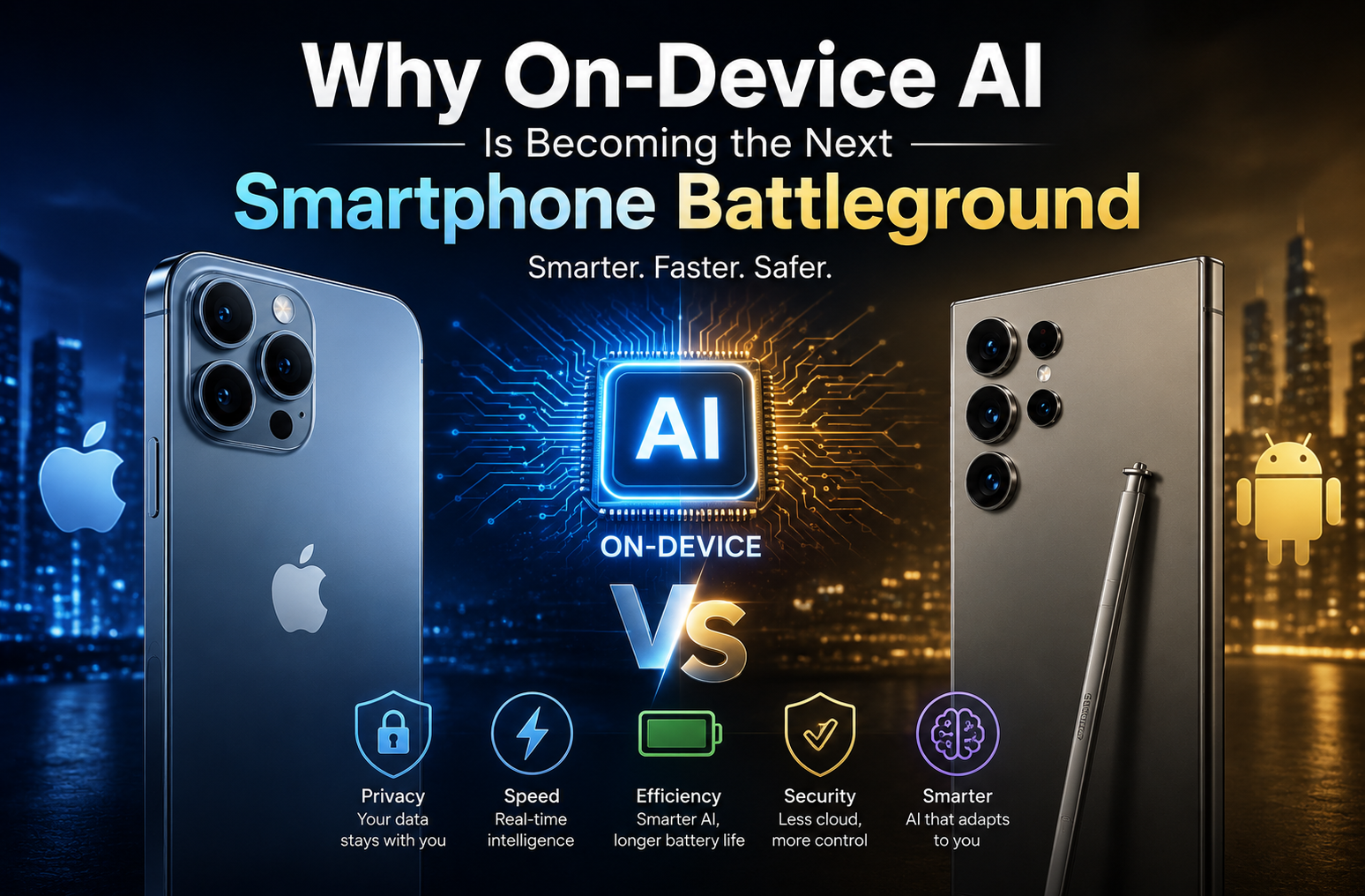
For years, flagship smartphone competition revolved around faster processors, sharper cameras, brighter displays, and longer battery life. In 2026, a different contest is taking shape: on-device artificial intelligence. Apple, Samsung, Google, Qualcomm, and other major players are increasingly treating local AI processing as a defining feature of premium phones rather than a background technical detail.
The shift matters because the next generation of mobile AI will not be judged only by how impressive a chatbot sounds. Users increasingly expect AI to work instantly, privately, and across everyday tasks such as writing, photography, translation, search, notifications, voice interaction, and personal organization.
Why On-Device AI Matters
Many early generative AI features depended heavily on cloud servers. On-device AI changes that equation by allowing more processing to happen directly on the smartphone, reducing latency and connectivity requirements for selected tasks.
Speed Is Becoming a User Experience Feature
Features such as live transcription, image enhancement, call assistance, text suggestions, and contextual recommendations feel more natural when they respond immediately. Low latency is becoming part of the overall perception of phone performance.
Privacy Could Become a Major Differentiator
Smartphones contain personal information including messages, photos, contacts and notes. Local processing can reduce how much information needs to leave the phone, making privacy architecture an important competitive factor.
The Hardware Race Is Changing
Smartphone processors are no longer marketed only around CPU and GPU performance. Neural engines and dedicated AI accelerators have become central parts of flagship chip design.
- Faster local language processing.
- Real-time image and video enhancement.
- Offline transcription and translation.
- More contextual system-wide assistance.
- Reduced dependence on constant internet access.
Smaller Models Are Becoming More Important
Smartphones have strict limits on memory, power consumption, and thermal performance. This is driving interest in smaller, highly optimized models capable of running efficiently on mobile hardware.
Battery Life Is the Hidden Challenge
Running AI locally consumes power and generates heat. The real competition is not simply about running AI on a phone, but about running useful AI continuously without imposing a major battery penalty.
Apple, Samsung, and Google Are Building Different AI Identities
The smartphone AI race is becoming a battle between ecosystems. Apple emphasizes deep integration and privacy, Samsung expands practical Galaxy AI features, and Google leverages Gemini while integrating AI throughout Android and Pixel experiences.
AI Could Become the Main Selling Point
As traditional hardware improvements become more incremental, AI gives manufacturers a new way to demonstrate visible differences through summarization, translation, photo editing, contextual assistance, and automation.
The Cloud Will Not Disappear
The likely future is hybrid: smaller and privacy-sensitive tasks run locally while demanding requests are routed to powerful cloud models. Users will simply expect the overall experience to be fast, accurate, and secure.
Conclusion
On-device AI combines hardware, software, privacy, battery efficiency, and ecosystem integration into a major strategic smartphone battleground. Consumers may increasingly choose phones based on how intelligently and efficiently the device assists them.