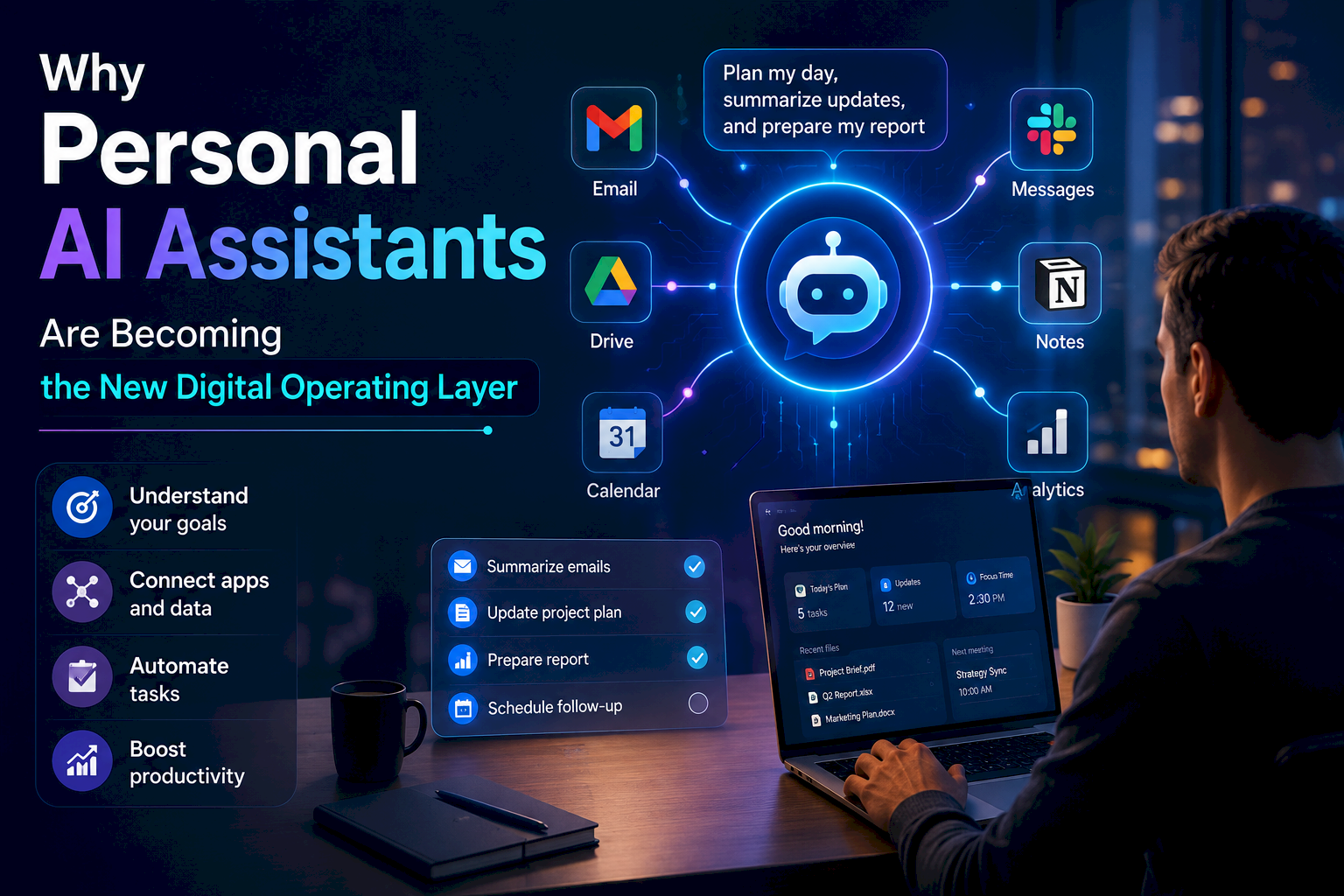
Why Personal AI Assistants Are Becoming the New Digital Operating Layer
Personal AI assistants are rapidly moving beyond the role of simple chatbots. Instead of answering isolated questions, they are beginning to connect applications, organize information, manage tasks, and support decisions across a user’s digital life.
This shift suggests that AI may become more than another app. It could emerge as a new operating layer that sits between people and the software they use every day.
From Chatbots to Digital Coordinators
The first generation of consumer AI tools focused mainly on conversation. Users entered a question, received an answer, and then copied the result into another application.
The newer generation is becoming more action-oriented. An AI assistant may be able to summarize documents, compare information, prepare drafts, organize calendars, track projects, search across files, and coordinate multiple tools within a single workflow.
The important change is not simply better language generation. It is the ability to understand goals and connect several digital actions together.
What Is an AI Operating Layer?
An operating layer is a system that helps users interact with multiple services through one consistent interface. Traditional operating systems manage hardware, files, applications, and permissions. A personal AI layer could perform a similar coordinating role across digital services.
Instead of opening several applications and completing each step manually, a user could describe the desired result. The AI assistant would then identify the required tools, collect the relevant information, and prepare or execute the necessary actions.
For example, a single request could involve:
- Reviewing recent messages and documents.
- Identifying important deadlines.
- Preparing a summary.
- Creating a task list.
- Drafting responses.
- Scheduling follow-up work.
Why This Model Is Attractive
Modern digital work is fragmented. People often switch between email, calendars, cloud storage, messaging platforms, browsers, note-taking tools, and project management systems.
Every switch requires attention and creates additional mental load. A personal AI assistant can reduce this friction by gathering information from multiple sources and presenting it in a more unified form.
Less Application Switching
Users may no longer need to remember where every piece of information is stored. The assistant could locate relevant content across approved services and bring it into the current task.
More Contextual Support
A capable assistant can use previous instructions, project information, and user preferences to produce results that are more relevant than generic recommendations.
Faster Routine Work
Administrative activities such as sorting information, summarizing updates, preparing drafts, and organizing follow-ups can consume a large part of the workday. AI can help reduce the time spent on these repetitive processes.
The Rise of Personalization
The long-term value of personal AI depends heavily on personalization. A useful assistant must understand how an individual works, which information matters, and what level of detail is preferred.
This does not mean the assistant should make every decision automatically. Instead, it should adapt to the user’s habits while preserving clear control over sensitive actions.
Effective personalization may include:
- Preferred writing style and tone.
- Frequently used applications.
- Important contacts and projects.
- Typical work schedules.
- Notification preferences.
- Rules for approving important actions.
Privacy and Trust Will Define Adoption
The more useful an AI assistant becomes, the more access it may require. This creates a major trust challenge. Users need to understand what information the assistant can access, how long data is retained, and which actions require confirmation.
Strong personal AI systems will need transparent permission controls rather than broad, permanent access. Users should be able to review connected services, remove access, inspect important actions, and limit the assistant to specific folders, accounts, or tasks.
Trust will also depend on reliability. An assistant that confidently performs the wrong action can create more problems than it solves. For this reason, high-impact actions should remain visible and reversible whenever possible.
Why Human Oversight Still Matters
AI assistants can accelerate work, but they do not eliminate the need for human judgment. Tasks involving negotiation, legal commitments, financial decisions, personal relationships, or strategic planning still require careful review.
The most practical model is likely to be collaborative. The AI prepares, organizes, recommends, and automates routine steps, while the user approves important decisions and remains responsible for the final outcome.
How Workflows May Change
As personal AI becomes more capable, the user interface of software may gradually change. Instead of navigating menus and remembering detailed commands, people may increasingly start with an intention.
A user might say:
- “Show me what requires attention today.”
- “Summarize the changes in this project.”
- “Prepare a response using the latest information.”
- “Organize these files by client and deadline.”
- “Find scheduling conflicts and suggest alternatives.”
The assistant would then translate the intention into a structured workflow. This could make complex software more accessible, especially for users who do not know every feature or command.
Potential Benefits for Businesses
Organizations may use AI operating layers to give employees faster access to internal information and reduce repetitive administrative work.
Potential benefits include:
- Faster document discovery.
- More consistent internal communication.
- Improved meeting preparation.
- Automated status reporting.
- Better knowledge sharing.
- Reduced time spent on routine coordination.
However, businesses will also need clear policies for data access, accuracy, accountability, and security.
The Risk of Becoming Too Dependent
Convenience can create dependency. If users allow an AI assistant to manage every detail, they may gradually lose awareness of how information is organized or how decisions are made.
This is similar to relying heavily on navigation software or automatic recommendations. The tool becomes useful, but the user may become less capable of operating without it.
A healthy approach is to use AI for acceleration rather than complete replacement. Users should still understand critical workflows, maintain access to original information, and review important outputs.
What the Future Could Look Like
Personal AI assistants may eventually become the primary interface for interacting with digital services. Applications will still exist, but users may access many of their functions through a conversational and context-aware layer.
The most successful assistants will likely combine four qualities:
- Strong reasoning and task planning.
- Secure access to approved services.
- Reliable execution with clear confirmations.
- Personalization without sacrificing privacy.
Conclusion
Personal AI assistants are evolving into something larger than chat tools. By connecting information, applications, and workflows, they have the potential to become a new digital operating layer for both individuals and organizations.
The transition will not depend only on intelligence. It will depend equally on trust, privacy, control, and reliability. The assistants that succeed will not be those that simply perform the most actions, but those that help users accomplish more while keeping them informed and in control.