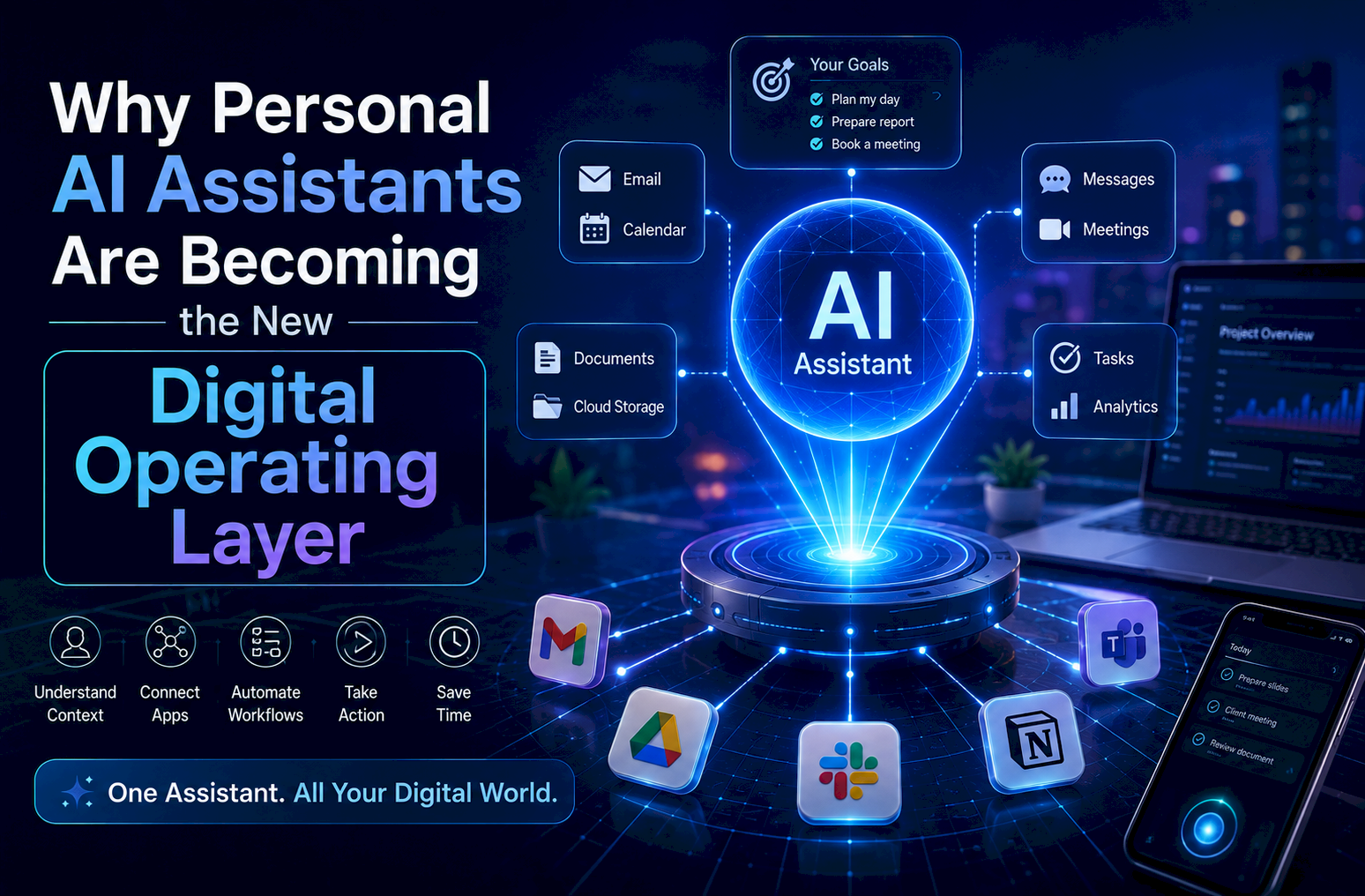
Why Personal AI Assistants Are Becoming the New Digital Operating Layer
Personal AI assistants are rapidly moving beyond basic question answering. They are beginning to act as an intelligent layer between users, applications, files, services, and devices. Instead of opening multiple apps and completing every step manually, people can increasingly describe what they want and allow an AI assistant to coordinate the process.
This shift may represent one of the most important changes in personal computing since the rise of mobile operating systems. The next major interface may not be a screen filled with icons, but an AI assistant that understands context, retrieves information, connects services, and completes tasks across the digital environment.
From Chatbots to Action-Oriented Assistants
The first generation of consumer AI tools focused mainly on conversation. Users typed questions, and the system generated answers, summaries, ideas, or text. While useful, these tools often remained separate from the applications where actual work happened.
The emerging generation of personal AI assistants is different. These systems are increasingly designed to perform actions, interact with connected services, and manage multi-step workflows. An assistant may search a calendar, review documents, draft an email, organize a task list, and prepare a meeting summary within a single request.
What Is a Digital Operating Layer?
A traditional operating system manages hardware, applications, files, permissions, and user interactions. A personal AI assistant does not replace the operating system itself, but it can create a new layer above it.
This intelligent layer may connect:
- Emails and messaging platforms.
- Calendars and meeting tools.
- Cloud storage and documents.
- Productivity and project-management apps.
- Search engines and knowledge sources.
- Smartphones, computers, and connected devices.
The assistant becomes a unified interface that helps users navigate these systems without manually switching between every application.
Why Apps Alone Are No Longer Enough
Modern users often rely on dozens of applications. Each app has its own menus, notifications, search tools, and data structure. This creates digital fragmentation, where important information is spread across different services.
Personal AI assistants can reduce this fragmentation by understanding the user’s goal instead of forcing the user to understand the structure of every app. For example, rather than opening email, calendar, cloud storage, and a video meeting platform separately, a user might ask:
“Prepare me for tomorrow’s client meeting and highlight anything that requires a decision.”
The assistant could then gather the relevant messages, files, notes, and schedule information before presenting a concise briefing.
Context Is the Real Advantage
The most valuable personal AI assistants will not simply provide generic answers. Their advantage will come from understanding context.
This context may include:
- The user’s current project.
- Previous conversations and decisions.
- Upcoming appointments.
- Frequently used documents.
- Preferred writing style.
- Daily routines and priorities.
With the correct permissions and privacy controls, this context allows the assistant to provide more relevant support. It can recognize what matters, reduce repeated explanations, and adapt its responses to the user’s actual workflow.
Personal AI Assistants and Workflow Automation
Traditional automation tools usually require users to build rules manually. A person must define triggers, conditions, and actions before the system can perform a task.
AI assistants can make automation more accessible by allowing users to describe workflows in natural language. Instead of configuring several technical steps, a user could say:
“Every time I receive an invoice, save it in the correct folder, extract the payment date, and add a reminder to my calendar.”
The assistant may translate that instruction into a repeatable workflow, reducing the need for complex setup.
The Rise of AI Agents
AI agents are systems designed to pursue a goal through multiple steps rather than responding only once. They may plan, use tools, check results, and adjust their actions.
In a personal assistant, agent-like capabilities can support tasks such as:
- Planning a trip across several booking services.
- Comparing expenses and organizing receipts.
- Preparing reports from multiple documents.
- Tracking deadlines across email and calendar.
- Coordinating tasks between several applications.
This makes the assistant more useful as an active digital partner rather than a passive information source.
Why the Interface Is Changing
For decades, computing interfaces have been based on menus, buttons, folders, and icons. These systems are powerful, but they require users to learn how software is organized.
Natural-language interfaces reverse this relationship. The user explains the goal, while the system determines which tools and steps are required.
This does not mean graphical interfaces will disappear. Instead, AI may become the first point of interaction, while traditional apps remain available for detailed control, verification, and advanced tasks.
Privacy and Permission Challenges
The same access that makes a personal AI assistant useful can also create significant privacy risks. An assistant that can read emails, access documents, manage calendars, and interact with financial or work-related services must be carefully controlled.
Important safeguards include:
- Clear permission settings.
- Visible records of completed actions.
- Confirmation before sensitive operations.
- Secure handling of personal data.
- The ability to revoke access at any time.
- Separation between personal and professional accounts.
Trust will become a major competitive advantage. Users are unlikely to rely on an assistant for important tasks unless they understand what data it can access and what actions it can perform.
The Risk of Over-Automation
Not every task should be fully automated. Personal AI assistants can make mistakes, misunderstand instructions, or act on incomplete information.
High-risk decisions involving money, legal agreements, medical information, security settings, or employment should include human review. The best assistant may not be the one that performs every action automatically, but the one that knows when to ask for confirmation.
How Personal Computing May Change
As personal AI assistants improve, users may spend less time navigating individual applications and more time managing goals. The assistant could become the main interface for daily digital activity.
A typical workflow might look like this:
- The user describes a goal.
- The assistant identifies the required information and tools.
- It creates a plan and requests necessary permissions.
- It completes low-risk actions automatically.
- It asks for approval before sensitive steps.
- It presents the result with a clear activity record.
This model transforms the computer from a collection of separate tools into a coordinated environment centered on the user’s intentions.
What Companies Need to Build
For this ecosystem to succeed, technology companies will need more than powerful AI models. They must also create reliable connections between applications, consistent permission systems, secure identity management, and transparent activity logs.
Applications may increasingly compete based on how well they work with AI assistants. Services with structured data, secure integrations, and clear APIs will be easier for assistants to use effectively.
The Future: One Assistant or Many?
It is not yet clear whether users will rely on one universal assistant or several specialized assistants. A general assistant may coordinate daily tasks, while specialized systems handle areas such as finance, healthcare, coding, education, or creative work.
The likely outcome is a layered ecosystem in which a primary personal assistant coordinates multiple services and specialized agents. The user may interact with one interface while several systems work behind the scenes.
Conclusion
Personal AI assistants are evolving into something larger than chatbots. They are becoming a new digital operating layer that connects information, applications, workflows, and devices around the user’s goals.
The most successful assistants will combine intelligence with reliability, privacy, transparency, and user control. As these systems mature, the defining feature of personal computing may no longer be the apps installed on a device, but the intelligence that coordinates them.