Artificial intelligence has often been associated with enormous data centers, expensive graphics processors, and models containing hundreds of billions of parameters. The most capable systems usually depend on powerful cloud infrastructure to process requests and generate detailed responses.
However, another category of artificial intelligence is gaining importance: small language models designed to run directly on smartphones, laptops, vehicles, cameras, home devices, and wearable technology.
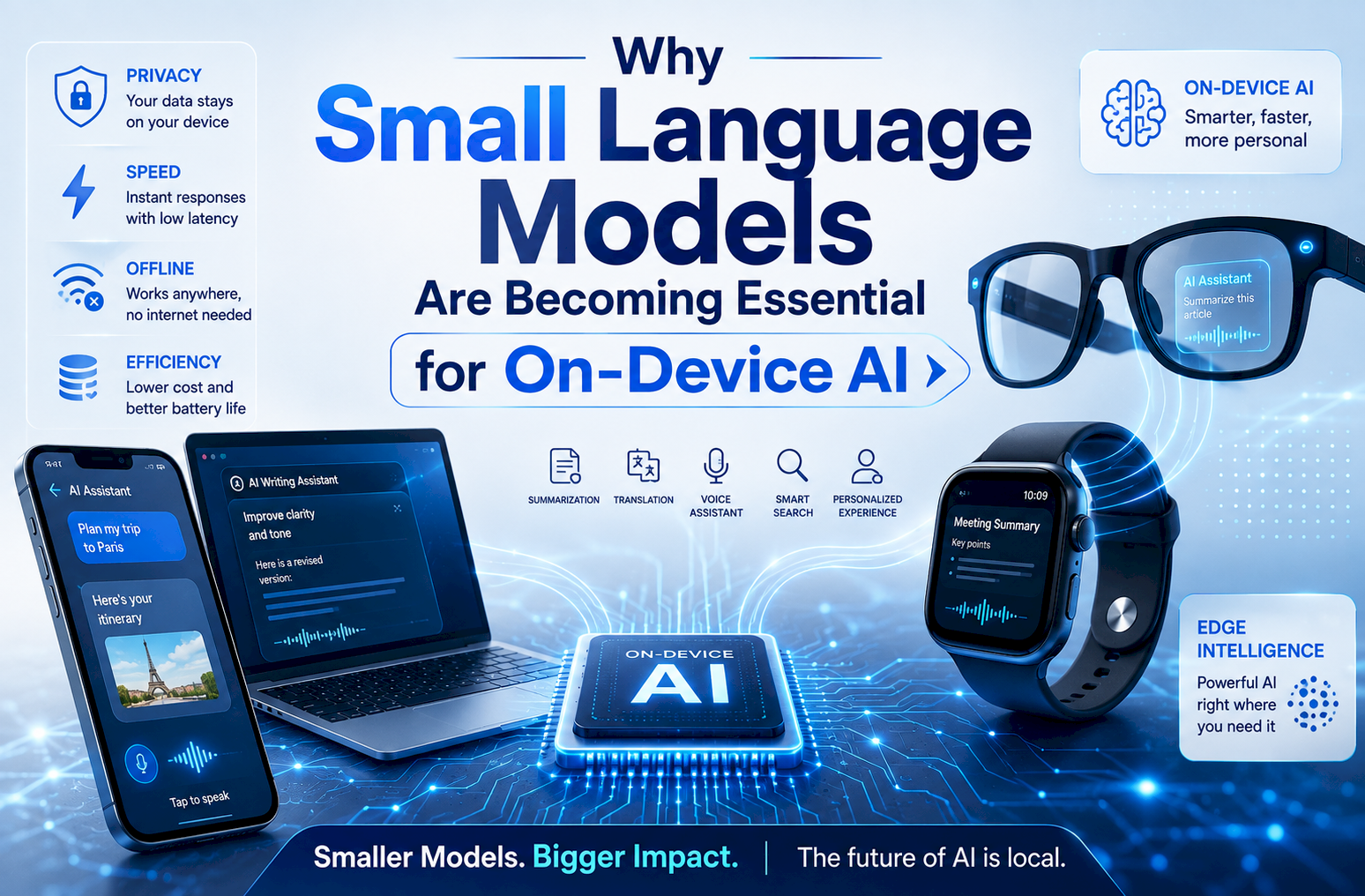
These compact models may not match the broad knowledge or advanced reasoning abilities of the largest cloud-based systems, but they offer something equally valuable: speed, privacy, reliability, lower operating costs, and the ability to work without a permanent internet connection.
What Is a Small Language Model?
A small language model is an artificial intelligence model designed with fewer parameters and lower computational requirements than a large language model. Its smaller size allows it to operate on devices with limited memory, battery capacity, and processing power.
The term “small” is relative. Some models may contain hundreds of millions of parameters, while others may contain several billion. What matters is that they are optimized to perform useful tasks without requiring the infrastructure of a large cloud platform.
Small models are often trained or fine-tuned for specific activities such as summarizing messages, rewriting text, translating short conversations, recognizing user intent, organizing notifications, or controlling device features.
Why On-Device AI Matters
Most generative AI services currently send user requests to remote servers. The server processes the request and returns the result to the device. This method provides access to powerful models, but it also introduces delays, privacy concerns, service costs, and dependence on network availability.
On-device AI changes this model by processing information locally. Instead of sending every message, image, audio recording, or document to an external server, the device can analyze the information itself.
This approach is especially useful for personal devices because they contain highly sensitive information, including private conversations, photographs, contacts, health data, financial details, locations, and daily routines.
Faster Responses Without Network Delay
One of the clearest advantages of small language models is speed. A locally installed model does not need to wait for information to travel to a data center and return through the internet.
For short tasks such as correcting a sentence, identifying an important notification, suggesting a reply, or understanding a voice command, local processing can provide an almost immediate response.
Low latency is particularly important in applications where even a brief delay feels unnatural, including voice assistants, augmented-reality glasses, vehicle controls, accessibility features, and real-time translation.
Stronger Privacy Through Local Processing
Privacy is one of the strongest reasons for moving artificial intelligence onto personal devices. When information is processed locally, fewer sensitive details need to leave the device.
A local model could summarize private messages, search through personal notes, classify photographs, or analyze health information without uploading the original content to an external service.
Local processing does not automatically guarantee privacy. Applications still need clear permissions, secure storage, reliable encryption, and transparent data policies. Nevertheless, reducing the amount of information transmitted to the cloud can significantly reduce exposure.
Artificial Intelligence That Works Offline
Cloud-based artificial intelligence becomes less useful when a device loses its internet connection. This limitation can affect travelers, field workers, drivers, emergency teams, and people living in areas with unreliable network coverage.
A small language model stored on the device can continue performing essential tasks offline. It may translate phrases, summarize saved documents, generate short responses, search local information, or help the user navigate device settings.
Offline operation also improves reliability. Important features do not become unavailable simply because a server is overloaded, a subscription has expired, or the network connection has failed.
Lower Costs for Companies and Developers
Running large artificial intelligence models in the cloud can be expensive. Every request consumes processing capacity, electricity, network bandwidth, and server resources.
For an application with millions of users, even a simple AI feature may generate a substantial infrastructure bill. Moving suitable tasks to the user’s device can reduce the number of requests sent to external servers.
This does not eliminate cloud costs completely, but it allows companies to reserve expensive models for tasks that genuinely require advanced reasoning, large amounts of knowledge, or complex content generation.
The Rise of Hybrid AI Systems
The future of personal artificial intelligence is unlikely to depend entirely on either local models or cloud models. A hybrid system can use both, depending on the complexity and sensitivity of each request.
The device may handle routine tasks locally, while sending more demanding requests to a larger model in the cloud. For example, a phone could summarize a notification locally but use a cloud model to analyze a long technical document.
A well-designed hybrid system can consider several factors before choosing where to process a task:
- The sensitivity of the user’s data.
- The complexity of the requested task.
- The availability and quality of the internet connection.
- The device’s battery level and processing capacity.
- The speed required for the response.
- The cost of using cloud infrastructure.
How Small Models Become More Capable
Reducing model size does not always require sacrificing usefulness. Researchers and developers use several techniques to make compact models more efficient.
Model Distillation
Distillation transfers knowledge from a larger model to a smaller one. The smaller model learns to reproduce useful patterns and responses without containing the full structure of the original system.
Quantization
Quantization reduces the numerical precision used to store and operate the model. This can lower memory usage and improve speed while preserving enough accuracy for many practical tasks.
Task-Specific Fine-Tuning
A compact model can become highly effective when trained for a limited set of tasks. A model designed specifically for email replies, device commands, or customer support may outperform a larger general model in that particular area.
Hardware-Aware Optimization
Models can be optimized for the processors, neural engines, and memory systems available inside a particular device. This helps developers use the hardware more efficiently and reduce power consumption.
Smartphones as Personal AI Computers
Modern smartphones already contain specialized processors capable of running machine-learning tasks. These chips have traditionally supported features such as facial recognition, photography enhancement, voice detection, and keyboard predictions.
Small language models expand these capabilities by allowing the phone to understand and generate natural language. The device could summarize calls, organize messages, rewrite text, extract information from screenshots, and provide suggestions based on local content.
Over time, the operating system may become more proactive. Instead of waiting for the user to open an application, the device could identify a task and offer assistance at the right moment.
Laptops and Personal Computers
Computers are another natural environment for local AI because they often provide more processing power, memory, and cooling capacity than smartphones.
A local model could search through documents, summarize meeting notes, assist with programming, organize files, classify email, or help users understand information stored across multiple applications.
Local AI may be especially valuable for companies that work with confidential information and cannot send internal documents to external services.
Wearable Devices Need Compact Intelligence
Smart glasses, watches, earbuds, and other wearable devices have strict limits on battery size, heat, memory, and processing power. Large models are not practical in these environments.
Small models can provide immediate assistance without forcing every interaction through a smartphone or cloud server. They may recognize commands, interpret sensor data, summarize information, or decide when a more powerful system is required.
This could make wearable technology feel more natural because the device can respond quickly and understand context without depending on a visible screen.
Artificial Intelligence Inside Vehicles
Vehicles increasingly depend on voice controls, navigation systems, cameras, sensors, and connected services. A small local model can help the vehicle understand natural commands and respond without waiting for a network request.
Local processing is important in a car because network coverage may change while driving. Basic controls, safety-related information, and navigation assistance should remain available even when connectivity is limited.
A vehicle could use local AI to interpret requests, summarize warnings, explain dashboard indicators, adjust settings, or identify patterns in the driver’s preferences.
The Limitations of Small Language Models
Small models are not suitable for every task. Their limited capacity may result in weaker reasoning, reduced factual knowledge, shorter context windows, and less reliable performance on complicated requests.
They may struggle with advanced research, long documents, complex programming, detailed analysis, or requests that require information beyond what is stored on the device.
Developers must therefore avoid presenting small models as universal replacements for larger systems. Their value comes from performing the right tasks efficiently, not from attempting to handle every possible request.
Battery Life and Heat Remain Major Challenges
Running artificial intelligence continuously can consume significant energy. Smartphones and wearable devices must balance model performance with battery life and temperature.
A model that produces excellent results but quickly drains the battery will not provide a practical user experience. Operating systems may need to limit background activity, schedule processing efficiently, and activate the model only when necessary.
Hardware manufacturers are also developing more efficient neural processing units that can run AI workloads using less power than traditional processors.
Personalization Without Sending Everything to the Cloud
One of the most promising uses of local AI is personalized assistance. A model operating on the device can learn from the user’s writing style, common tasks, preferred applications, and routines.
This personalization could improve suggested replies, reminders, search results, accessibility options, and device automation.
The challenge is to provide meaningful personalization without creating an uncontrolled profile of the user. Clear permission systems and local storage controls will be essential.
Small Models Could Reshape Application Design
Applications have traditionally been designed around menus, buttons, and separate screens. Local language models could introduce a more flexible interface based on natural instructions.
Instead of searching through settings, the user might simply describe the desired result. The local model could understand the request and connect it to the appropriate system function.
This shift may make software easier to use, but it also requires strict boundaries. The model must clearly explain what it intends to change and ask for confirmation before performing sensitive actions.
Security Must Be Built Into the Model
A model that can access private files, messages, microphones, cameras, and device controls creates new security risks. Attackers may attempt to manipulate it through malicious instructions or deceptive content.
On-device AI systems need strong permission controls, isolated processing, secure model updates, and limits on the actions they can perform.
Users should also be able to see which information the model accessed and which actions it completed. Transparency will be necessary for building trust.
Where Small Models Are Most Useful
Small language models are especially effective when a task is frequent, predictable, time-sensitive, or based on private local information.
- Summarizing notifications and short messages.
- Generating suggested replies.
- Rewriting text in different tones.
- Translating short conversations offline.
- Searching through locally stored documents.
- Understanding voice commands.
- Organizing photographs and files.
- Explaining device settings.
- Supporting accessibility features.
- Filtering sensitive or unwanted content.
A Different Kind of AI Competition
The artificial intelligence industry has often focused on building the largest and most capable model. On-device AI introduces a different competition: creating the most useful model under strict limits.
Success depends on how much intelligence can be delivered using limited memory, energy, and processing power. A smaller model that runs instantly and privately may provide more everyday value than a larger model that requires constant cloud access.
This will encourage closer cooperation between model developers, operating system designers, application companies, and chip manufacturers.
Conclusion
Small language models are becoming an essential part of the transition from cloud-only artificial intelligence to intelligence that exists directly inside personal devices.
Their advantages include faster responses, stronger privacy, offline availability, lower operating costs, and deeper integration with smartphones, computers, vehicles, and wearable technology.
They will not replace large cloud models entirely. Instead, the most effective systems will combine local and cloud intelligence, selecting the right model for each task.
As hardware becomes more efficient and compact models become more capable, artificial intelligence will increasingly operate in the background of everyday devices, providing assistance without sending every interaction to a distant server.